

Quick Summary
- You can try calling back using *69, but it's not guaranteed. Dialing *69 may reconnect you to the last caller, even if the number was hidden. However, it only works for the most recent call and depends on your carrier's support.
- You cannot always reveal a private number directly. If the caller has fully hidden their caller ID at the network level, your phone never receives the number—meaning no app or trick can uncover it.
- The best way to identify a caller is through indirect methods. Checking voicemail, analyzing call patterns, and matching the call with recent activities (like deliveries or sign-ups) can help you figure out who's calling.
- Your mobile carrier is the most reliable source for identification. Telecom providers can access call metadata and assist in serious cases such as harassment or fraud, though they usually require a valid reason or a legal request.
- Always verify before calling back to avoid scams. Instead of returning unknown calls directly, use official company websites or trusted contact details to ensure you're communicating safely. For business-grade options, review AI Phone Answering Services Guide (2026).
What Is a Private Number?
A private number (also called No Caller ID, Blocked, or Unknown) is a call where the caller has intentionally hidden their number. If the number was never transmitted to your phone, you cannot directly call it back like a normal missed call.
Can You Call Back a Private Number?
Yes, but only in certain cases.
- If your carrier supports call return, you might be able to call it back.
- If the number is fully hidden at the network level, you can't retrieve it directly.
Top 5 Methods to Call Back a Private Number
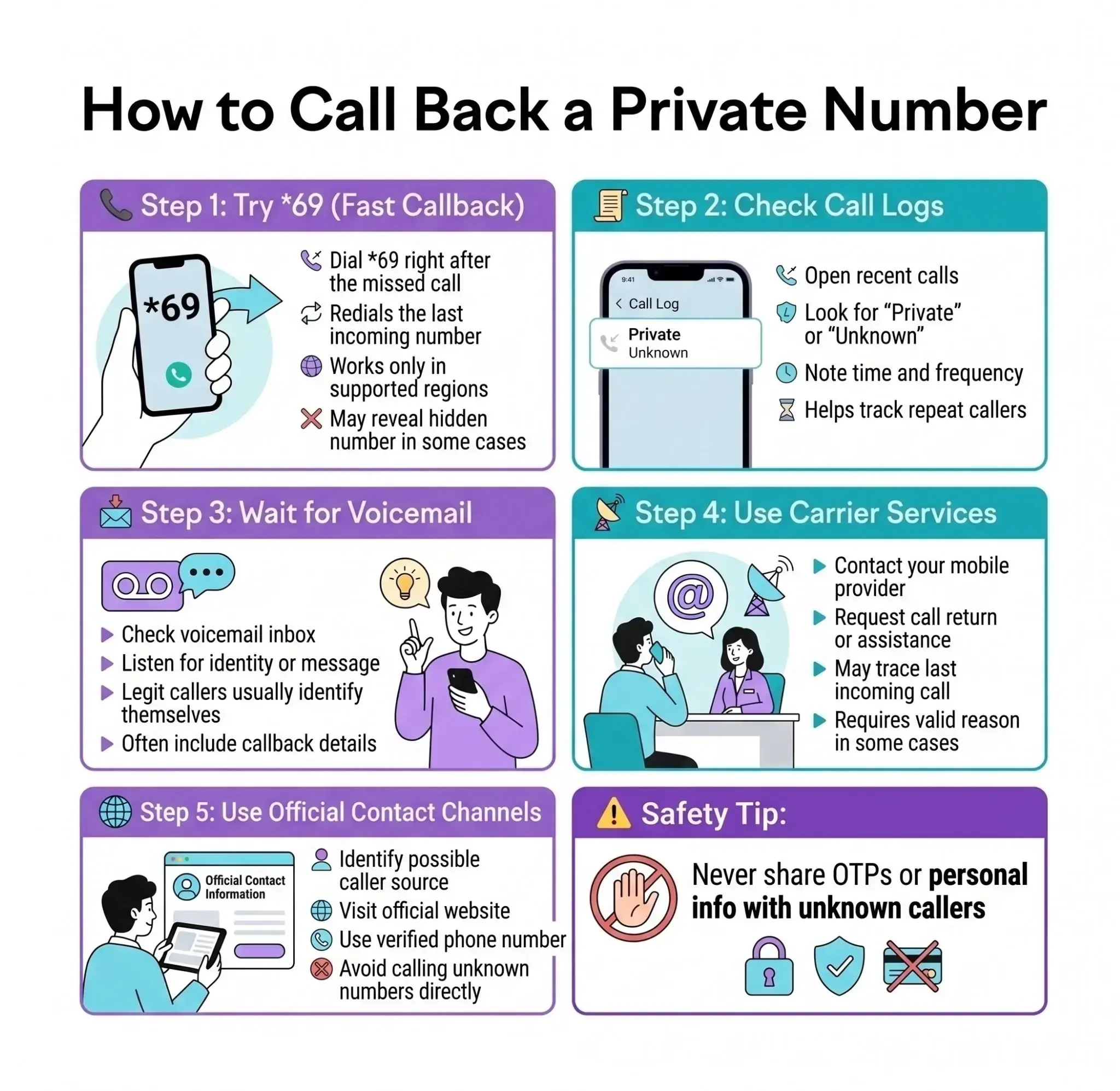
The following are the best five ways to call back a No Caller ID number. Small teams can also compare automation options in Automated Answering Service for Small Businesses:
- Dial *69 to Return the Last Call
- Dial *69 immediately after receiving the call
- Automatically redials the most recent incoming number
- May reveal the number depending on your carrier
- Works only for the last call received
- Availability varies by region and network provider
- Check Your Call Logs for Clues
- Open your recent call history
- Look for entries labeled "Private" or "Unknown."
- Note the time and frequency of calls
- Identify patterns like repeated attempts
- Helps in understanding the caller's behavior
- Wait for Voicemail or Follow-Up
- Check if the caller left a voicemail
- Look for SMS or email follow-ups. You can also use Missed Call Text Back for Home Service Businesses to respond faster.
- Legitimate callers usually provide identification
- Use the provided number to call back safely
- Avoid calling back without confirmation
- Use Carrier Call Return Services
- Use your telecom provider's call return feature
- Works at the network level, not just your phone
- Can reconnect you with the last caller
- May work even if the number was hidden
- Not all carriers or regions support this feature
- Call Back via Official Channels
- Identify the possible source of the call
- Visit the company's official website
- Use their verified contact number
- Avoid calling unknown or suspicious numbers directly
- Ensures safe and secure communication
Quick Summary: How to Call Back a Private Number?
| Method | How It Works | Success Rate | Best For | Limitations |
|---|---|---|---|---|
| *Dial 69 | Redials the last incoming call automatically | ⭐⭐⭐ | Quick callback attempt | Works only for the last call, not supported everywhere |
| Call Logs Review | Check recent calls for timing and details | ⭐⭐ | Tracking missed calls | Doesn't reveal the hidden number |
| Wait for Voicemail | The caller leaves contact details for a callback | ⭐⭐⭐⭐ | Legitimate callers | Not all callers leave messages |
| Use Carrier Call Return | Network-based callback service | ⭐⭐⭐ | Supported regions/carriers | May fail if the number is fully hidden |
| Contact the caller via Official Channels | Call back using the verified company number | ⭐⭐⭐⭐⭐ | Safe communication | Requires identifying the caller first |
Top 7 Methods to Identify a Private Number
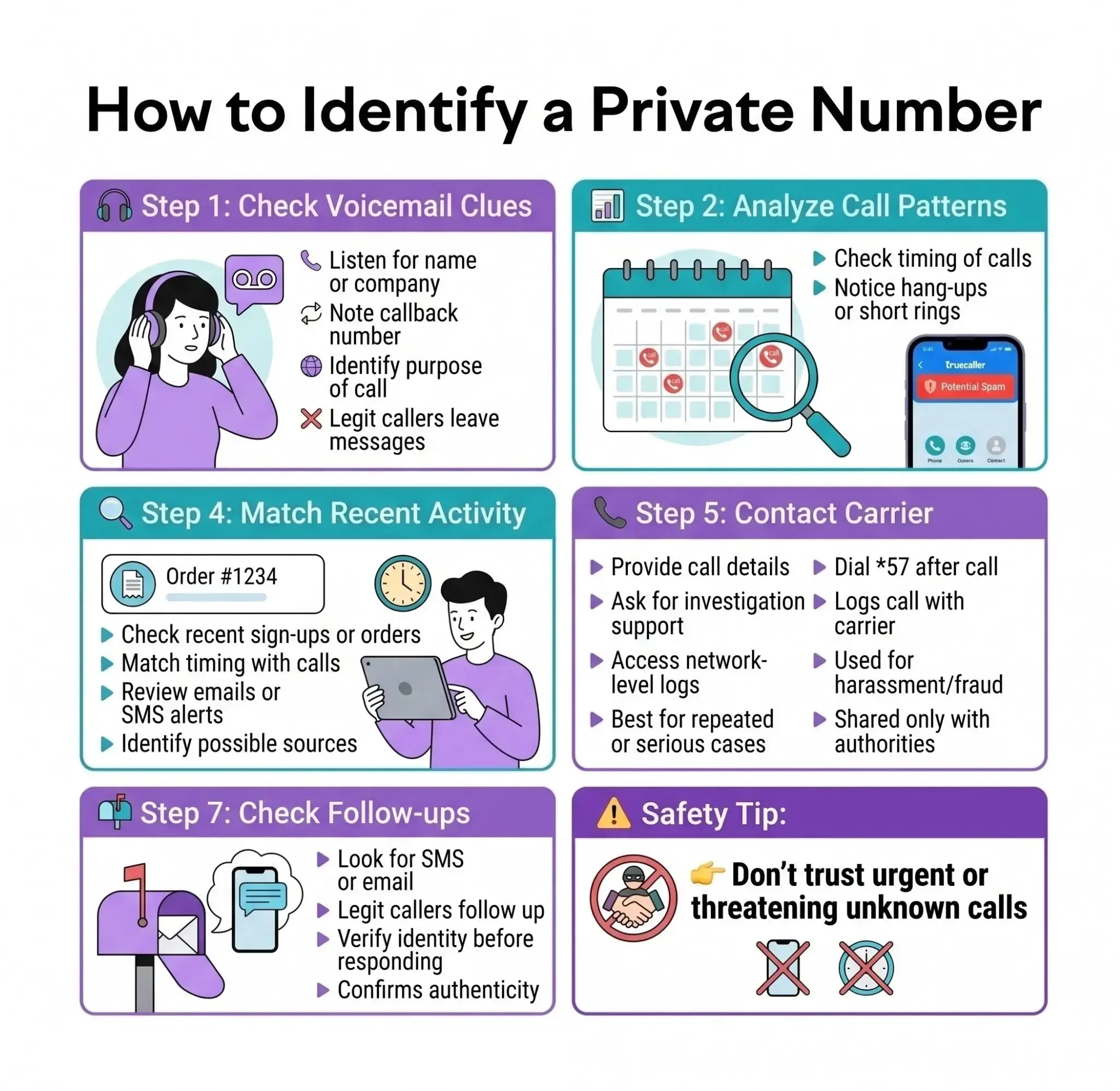
The following are the best five ways to identify a No Caller ID number:
- Analyze Voicemail for Identity Clues
- Check if the caller left a voicemail
- Listen for the name, company, or purpose of the call
- Note any callback number provided
- Legitimate callers usually identify themselves
- Lack of voicemail can indicate low priority or spam
- Observe Call Behavior Patterns
- Track the time of day the calls occur
- Check how often the number calls you
- Notice if calls disconnect quickly or continue ringing
- Repeated calls during business hours may indicate a company
- Late-night or frequent hang-ups may signal spam or prank calls
- Use Caller ID Apps (With Limits)
- Install apps like Truecaller or Hiya
- Let the app scan incoming calls
- Identify numbers based on global databases
- Detect spam or reported callers
- Keep in mind: apps can't reveal fully hidden numbers
- Perform a Reverse Context Check
- Think about recent activities (orders, sign-ups, inquiries)
- Match call timing with expected communications
- Check emails or SMS around the same time
- Identify if a business might be trying to reach you
- Helps connect the call to a real-world action
- Contact Your Mobile Carrier
- Reach out to your telecom provider
- Provide call details (time, date, frequency)
- Ask about tracing or identifying options
- Carriers can access network-level call data
- Identification may require a valid reason or legal process
- Use Call Trace (*57) for Serious Cases
- Dial *57 immediately after the call
- Activates a carrier-level trace
- Logs the caller's details internally
- Useful in harassment or fraud situations
- Results are shared only with authorities, not directly with you
- Check for Follow-Up Communication
- Look for SMS, email, or additional calls
- Legitimate callers often try multiple channels
- Check if any message includes identity or purpose
- Verify the sender before responding
- Helps confirm whether the call was genuine
Quick Summary: How to Identify a Private Number?
| Method | How It Works | Success Rate | Best For | Limitations |
|---|---|---|---|---|
| Voicemail Analysis | Caller reveals identity or purpose | ⭐⭐⭐⭐ | Business or important calls | No help if no message left |
| Behavior Pattern Analysis | Analyze timing, frequency, and call habits | ⭐⭐⭐ | Detecting spam vs legit | Not 100% accurate |
| Caller ID Apps | Match calls with spam databases | ⭐⭐ | Filtering known spam | Cannot reveal hidden numbers |
| Reverse Context Check | Match call with recent activity (orders, signups) | ⭐⭐⭐ | Expected calls | Indirect method only |
| Carrier Support | Telecom provider checks call metadata | ⭐⭐⭐⭐⭐ | Serious or repeated cases | May require a legal request |
| *Call Trace (57) | Logs call for investigation | ⭐⭐⭐⭐ | Harassment or fraud | Number not shown to the user |
| Check SMS/Email Follow-ups | Identify the caller through other channels | ⭐⭐⭐⭐ | Legitimate businesses | Not always available |
Takeaway
You can sometimes call back a private number using tools like *69, but it’s not always possible if the number is fully hidden. The best approach is to identify the caller first through voicemail, call patterns, or carrier support, and always verify before returning any unknown call to avoid scams and protect your privacy. If you run a service company, see Home Services Answering Service for Plumbers and Contractors for practical workflows. If your issue is that hidden calls are not ringing at all, follow this guide to unblock private calls on Android and iPhone.