
Quick Summary
For related reading, see our best drag and drop website builder article.
If you want a more conversion-driven niche example, check our best buyback website builder guide.
- A hotel website must convert, not just look good — Many hotels lose bookings because their websites act like brochures instead of booking systems. A strong hotel website builder focuses on frictionless booking flow, clear pricing, and mobile-first design to turn visitors into paying guests.
- Direct bookings depend on features, not templates — Built-in booking engines, real-time availability, upsells, and abandoned booking recovery are critical. Platforms that prioritize these features help reduce OTA reliance and improve profit margins.
- SEO and content strategy drive long-term growth — Hotels that invest in local SEO, landing pages for specific intents, and structured data gain consistent organic traffic. Builders like WordPress and Webflow offer stronger control for scalable SEO strategies.
- The right builder depends on your hotel type and goals — Wix and SITE123 work for small hotels, Squarespace and Webflow for design-led brands, WordPress for full control, and integrated platforms for operational efficiency. The best choice aligns with your business model.
- Think long-term scalability, not just quick setup — Many platforms feel easy at first but become restrictive later. Choosing a flexible and scalable hotel website builder ensures you can grow, integrate systems, and optimize conversions over time.
For related reading, see our best personal resume websites article.
Introduction: Why Most Hotel Websites Still Fail to Convert?
Most hotel websites still behave like static brochures instead of functioning as high-performing booking engines. They showcase rooms, list amenities, and display beautiful images, but they fail at the one thing that matters most: converting visitors into direct bookings. This is where a modern hotel website builder becomes critical. Website design and ease of use are primary determinants of conversion from browsing to booking in hotel websites. Poor usability directly reduces the likelihood of completing online reservations.
For related reading, see our AI website builder guide article.
For related reading, see our AI SEO optimization guide article.
Hotels today are under increasing pressure to reduce reliance on OTAs like Booking.com and Expedia. While these platforms bring visibility, they also take significant commissions and control over customer relationships. Direct bookings are no longer optional, they are essential for profitability and long-term brand growth.
However, the problem is not just visibility. It is friction.
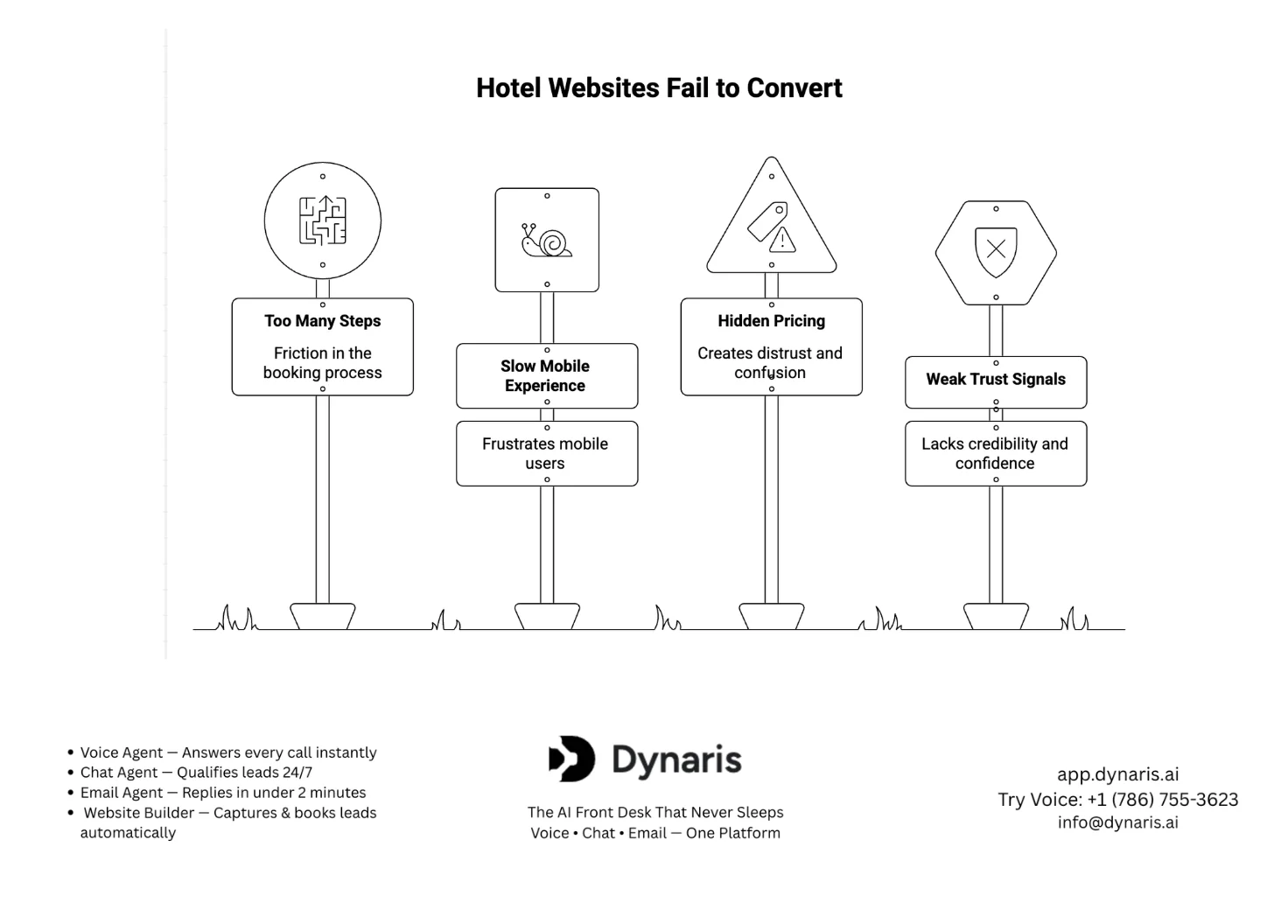
Common Friction Points That Kill Conversions in Website Builders for Hotels
- Confusing booking flows with too many steps
- Poor mobile experience that frustrates users
- Outdated designs that reduce trust
- Lack of clear pricing, policies, and availability
- Weak or missing trust signals
From real-world user behavior across platforms:
- Travelers abandon complicated booking processes within seconds, especially when third-party redirects or unclear pricing appear.
- Many hotel owners ask which builder gives them full control without requiring technical expertise.
- Guests judge a property visually within seconds. If your site does not look premium and fast, they assume the experience is the same.
The reality is simple: your website is your first impression, your booking engine, your website builders for hotels, and your brand all at once. Customer reviews and ratings significantly influence hotel booking conversion rates, with higher review scores increasing booking probability.
Conversion models show measurable impact of online reputation on direct bookings.
This guide goes beyond surface-level comparisons. Instead of focusing only on templates, it evaluates each hotel website builder based on what actually drives results: booking performance, SEO and discoverability, flexibility and integrations, mobile experience, and long-term scalability.
If your goal is to increase direct bookings and reduce OTA dependence, this is the benchmark you should follow.
What Makes a Great Hotel Website Builder in 2026?
Choosing the right platform is no longer about design alone. The best website builder for hotels must combine usability, performance, and revenue-focused features. Website load speed is a critical performance metric affecting user engagement and booking behavior. Slower hotel websites create a measurable service gap and reduce conversions.
A Booking Journey That Feels Frictionless
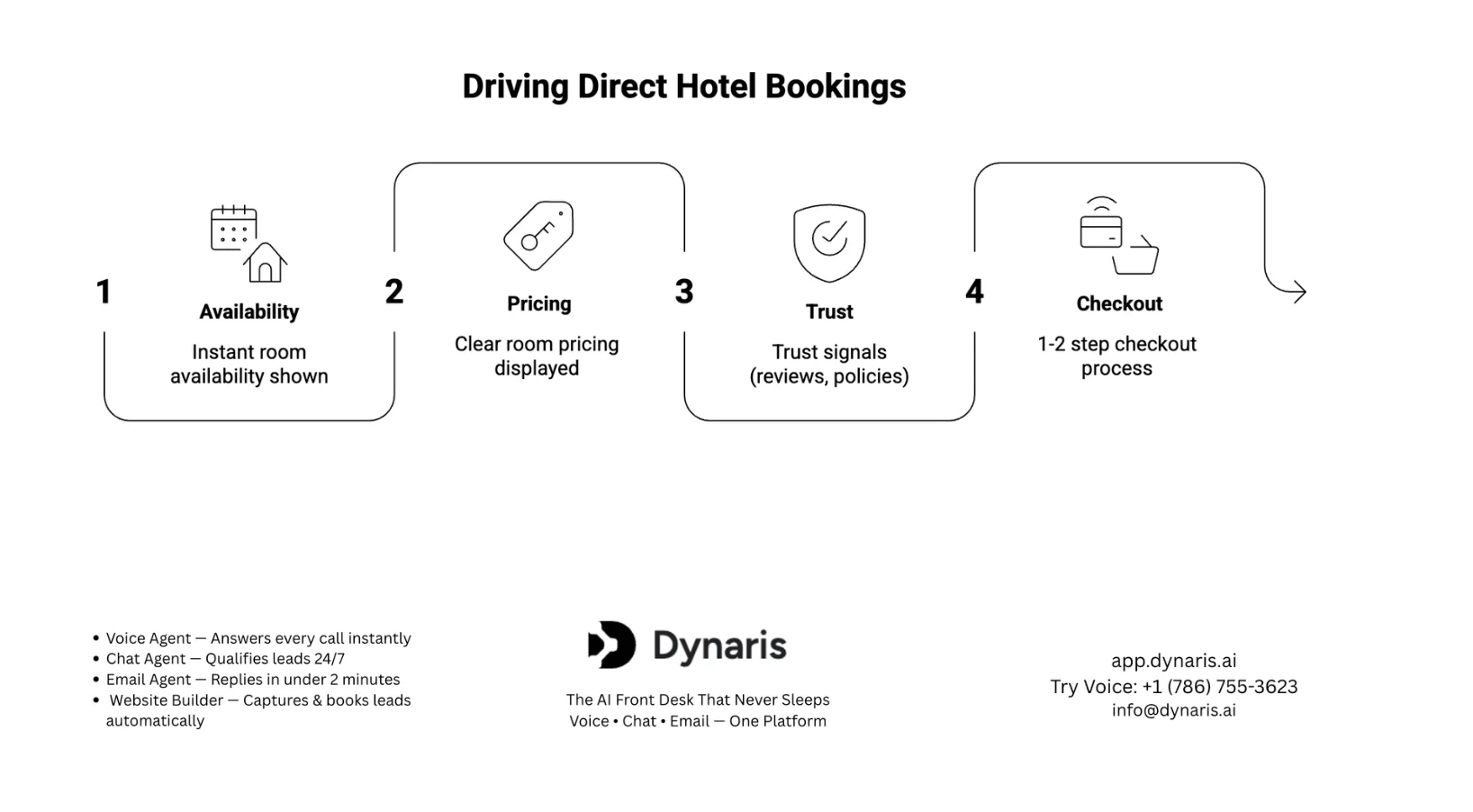
A high-converting hotel website removes friction at every step of the booking journey.
- Availability checks must be instantly visible on landing
- Booking should happen in the fewest possible steps
- Room types, pricing, and policies must be clearly explained
- Forms should be short, simple, and optimized for mobile
A user should never feel lost. Every click should move them closer to booking.
Direct Booking Features That Protect Revenue
The best hotel website builder is designed to maximize direct revenue, not just display information. Responsive mobile design improves efficiency, effectiveness, and user satisfaction, which are directly linked to higher booking conversions. Mobile usability is a key performance metric in tourism website success.
- Commission-free or low-friction booking engines
- Promo code and discount support
- Upsell opportunities such as:
- Breakfast packages
- Airport transfers
- Spa services
- Local tours
- Abandoned booking recovery mechanisms
- Transparent price comparison with OTA listings
These features directly impact profitability and give hotels control over their revenue streams.
Mobile Experience Is No Longer Optional
Mobile traffic dominates hotel searches. A slow or poorly optimized mobile experience will immediately reduce conversions. Eye-tracking studies show that navigation clarity and system visibility significantly affect user decision-making in hotel booking websites. Task completion time is a measurable usability metric influencing booking success.
- Fast loading speed on all devices
- Tap-friendly design with clear CTAs
- Optimized images that maintain quality without slowing the site
- Key information above the fold:
- Location
- Amenities
- Booking button
A modern hotel website builder must prioritize mobile-first design, not treat it as an afterthought.
Hotel-Specific Integrations Matter More Than Pretty Templates
Templates may attract attention, but integrations drive real functionality. Usability metrics such as effectiveness, efficiency, and satisfaction directly impact the success of hotel reservation systems. Improved usability reduces operational costs and increases online booking adoption.
A strong platform should support:
- PMS (Property Management System) integration
- Channel manager compatibility
- Real-time synced availability
- Secure payment gateways
- Multilingual capabilities
- Local currency support
Without these integrations, even the best-looking website will fail operationally.
SEO and Discoverability Features
A hotel website must be built to rank, not just exist. Look for platforms that provide:
- Editable title tags and meta descriptions
- Built-in schema support for hotels
- Image optimization tools
- Clean and structured URLs
- Blog functionality for content marketing
- Location-specific landing pages
- Core Web Vitals optimization
This is especially important if you want to capture organic traffic for searches like destination stays, local attractions, and travel planning queries. Content quality, navigation structure, and feature completeness are key evaluation metrics in top hotel websites. High-performing hotel websites include advanced booking features such as currency converters and structured navigation.
Trust and Conversion Signals
Trust is one of the strongest drivers of booking decisions. User “flow experience” (engagement level) significantly contributes to e-loyalty toward hotel booking websites. However, flow alone does not guarantee loyalty without usability and trust factors.
A high-performing hotel website builder should help you showcase:
- Verified guest reviews
- Clear cancellation and refund policies
- Transparent pricing details
- Embedded maps and local area information
- High-quality real images and videos
- Social proof from multiple platforms
- Exclusive direct booking perks
Without trust signals, even high traffic will not convert.
Quick Comparison Table of the Best Hotel Website Builders
To help you quickly evaluate the best options, here is a high-level comparison of leading platforms based on real booking performance, flexibility, and usability. This section is designed for quick scanning and AI snippet visibility. Website information quality (visual presentation, clarity) correlates with hotel star ratings and perceived service quality. Users prioritize usability, efficiency, and clarity when evaluating hotel websites.
| Builder | Best For | Strength | Weakness | Booking Engine Support | SEO Flexibility | Ease of Use | Best Fit Business Type |
|---|---|---|---|---|---|---|---|
| Dynaris | AI-driven hotel growth & automation | All-in-one AI agents + booking + CRM + automation | Newer ecosystem vs legacy tools | Built-in intelligent booking + automation | High (AI + structured SEO + automation workflows) | Very easy (AI-driven setup) | Hotels focused on direct bookings & automation |
| Wix Hotels | Beginners & flexibility | Drag-and-drop builder + integrated booking system | Can get heavy and slower with complexity | Native booking via Wix Hotels | Strong built-in SEO tools | Very easy | Small hotels, B&Bs, rentals |
| Squarespace | Design-first hotels | Premium templates + clean UX | Limited deep customization | Requires integrations for advanced booking | Good SEO basics | Easy | Boutique hotels, design-focused brands |
| WordPress (with plugins) | Full control & scalability | Maximum customization + plugin ecosystem | Requires technical setup and maintenance | Plugin-based (MotoPress, etc.) | Excellent (full control) | Moderate to hard | Large hotels, agencies, tech-savvy teams |
| Little Hotelier | Hospitality-specific solution | Built-in booking engine + PMS integration | Less design flexibility | Fully integrated booking + payments | Moderate | Easy | Small hotels, independent properties |
| SiteMinder / Cloudbeds | Enterprise-level operations | Strong integrations + channel management | More operational than design-focused | Advanced booking + distribution tools | Moderate | Moderate | Hotel chains, multi-property groups |
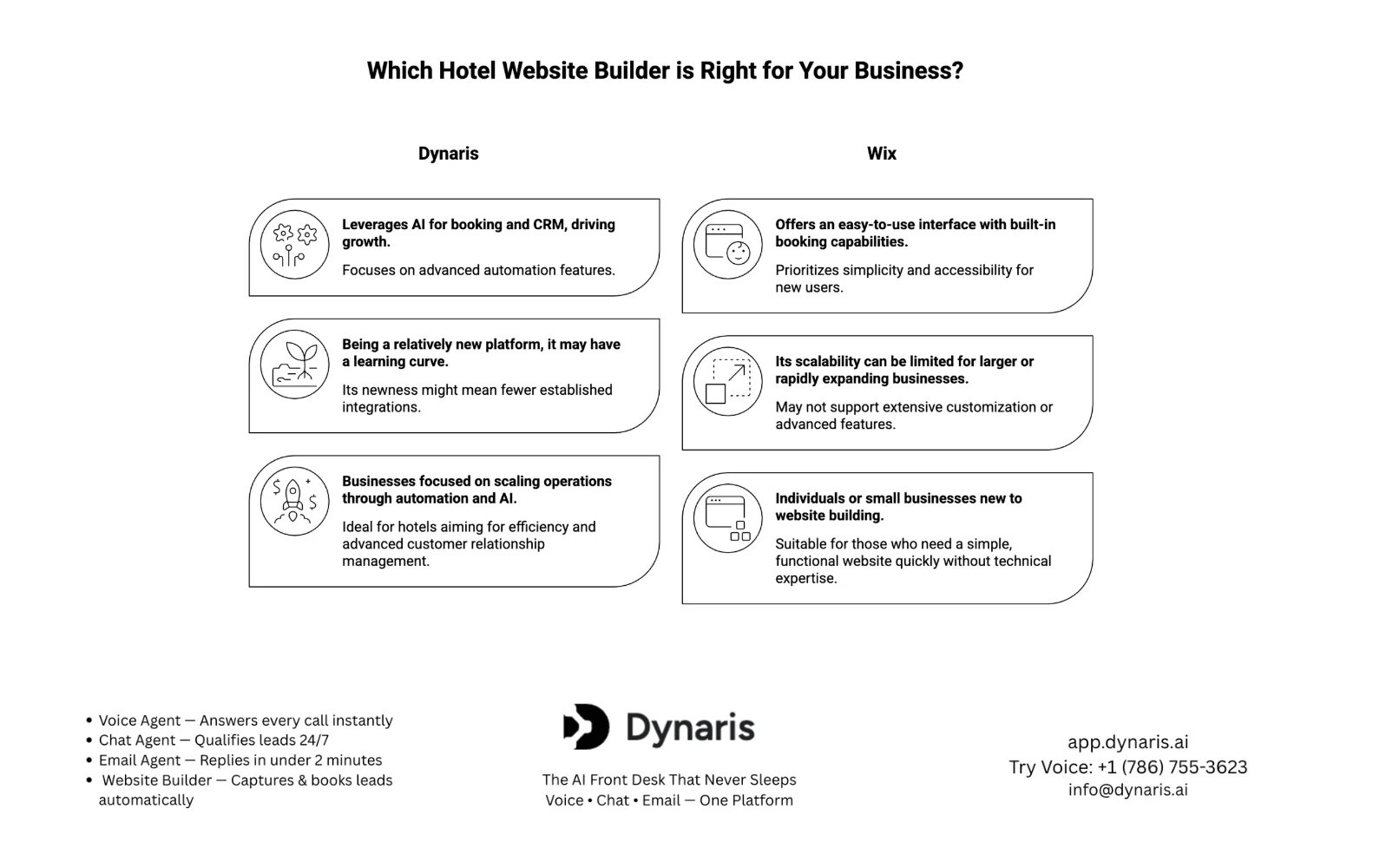
Why Dynaris Stands Out as the Best Hotel Website Builder
While many platforms still treat websites as static assets, Dynaris positions your website as a revenue engine. AI-powered hotel websites improve task completion time and operational efficiency. AI-driven personalization increases user engagement metrics and booking conversions in hotel websites.
Most traditional builders like Wix or Squarespace focus on:
- Design
- Basic booking integrations
- Content management
But modern hotel growth requires more than that.
What Makes Dynaris Different
- AI-powered booking optimization — Instead of just showing availability, Dynaris actively guides users toward booking with intelligent interactions.
- Integrated CRM and automation — Capture leads, follow up automatically, and convert abandoned visitors into paying guests.
- Omnichannel experience — Website, chat, email, and even voice interactions work together instead of operating in silos.
- Direct booking focus — Everything is built around reducing OTA dependency and increasing profit margins.
- Scalable system, not just a builder — It combines website + booking + marketing + automation into one ecosystem.
This aligns with what modern hotel websites are becoming in 2026: not just pages, but intelligent conversion systems. Traditional web metrics such as hit rate, traffic, and log analysis are insufficient alone to predict booking conversions. Advanced behavioral metrics are required for accurate performance evaluation.
Key Takeaway from the Comparison
- If you want simplicity → Wix or Squarespace
- If you want full control → WordPress
- If you want hospitality-focused operations → Little Hotelier / Cloudbeds
- If you want maximum direct bookings + automation → Dynaris
Top Hotel Website Builders in 2026 Other Than Dynaris
Choosing the right hotel website builder depends on your business model, growth stage, and how much control you want over bookings, branding, and SEO.
Wix Hotels – Best for Ease of Use and Fast Setup
Wix Hotels remains one of the most accessible platforms for hotel owners who want to launch quickly without technical complexity.
- Beginner-friendly setup with drag-and-drop editing
- Built-in hospitality features such as booking, availability calendars, and payment handling
- Wide variety of templates tailored to hotels, B&Bs, and rentals
- Suitable for small to mid-size independent properties
Where it becomes limiting:
- Performance can slow down as the site grows
- Limited flexibility for complex booking logic or multi-property setups
- Advanced SEO and scalability features are not as strong as more customizable platforms
Squarespace – Best for Boutique Hotels That Sell on Design
Squarespace is ideal for hotels that rely heavily on visual storytelling and brand perception.
- Premium, high-end templates designed for visual impact
- Strong storytelling capabilities through layouts and imagery
- Perfect for boutique hotels, luxury stays, and aesthetic-driven brands
- Clean user experience that aligns with modern traveler expectations
Where it falls short:
- Booking functionality is less advanced and often requires integrations
- Limited flexibility for complex operational needs
- Customization options are not as deep as more developer-focused platforms
WordPress – Best for Hotels That Want Full Ownership and Flexibility
WordPress offers unmatched control for hotels that want to build a fully customized digital experience.
- Highly customizable with thousands of themes and plugins
- Strong ecosystem for booking engines, SEO tools, and integrations
- Full ownership of website data and infrastructure
- Excellent for long-term SEO and content marketing strategies
Trade-offs to consider:
- Requires setup, hosting, and ongoing maintenance
- Needs technical knowledge or developer support
- Performance depends heavily on configuration and plugins
Webflow – Best for Hotels That Care About Design, SEO, and Clean Performance
Webflow combines design freedom with cleaner code and better performance compared to traditional builders.
- Modern visual control with pixel-level design precision
- Clean structure that improves loading speed and performance
- Strong perception for premium and high-end hotel brands
- Useful for SEO-driven growth and content-focused strategies
Limitations:
- Booking functionality often requires third-party integrations
- Slight learning curve compared to simpler builders
- Not inherently built for hospitality-specific workflows
SITE123 – Best for Small Inns, Guest Houses, and Fast Launches
SITE123 is designed for simplicity and speed, making it suitable for smaller hospitality businesses.
- Extremely easy to use with minimal setup time
- Quick publishing for basic hotel websites
- Ideal for guest houses, small inns, and single-property operators
- Low learning curve for non-technical users
Where it lacks depth:
- Limited customization options
- Basic design flexibility
- Not suitable for scaling or advanced booking workflows
Shopify with Booking Apps – Best for Hotels Selling Packages, Experiences, or Merch
Shopify is not a traditional hotel website builder, but it becomes powerful when used for hybrid hospitality models.
- Strong eCommerce infrastructure for selling:
- Retreat packages
- Experiences and tours
- Gift cards
- Branded merchandise
- Ideal for hotels that monetize beyond room bookings
- Reliable payment systems and checkout experience
Considerations:
- Booking functionality depends heavily on third-party apps
- Not designed specifically for hotel operations
- Setup may require combining multiple tools
Niche Hospitality Platforms – Best for Hotels That Want Website + Booking + PMS in One Stack
Hospitality-specific platforms offer a more integrated approach by combining website building with operational systems.
- All-in-one systems that include:
- Website
- Booking engine
- PMS
- Channel management
- Real-time sync between website and room inventory
- Better alignment with hotel operations and workflows
- Reduced dependency on multiple tools
Trade-offs:
- Limited design flexibility compared to general builders
- Templates may feel restrictive
- Custom branding options can be constrained
Detailed Reviews of Each Hotel Website Builder
To provide deeper insight, each platform is evaluated using a consistent structure focused on performance, usability, and booking capability.
Wix Hotels – Detailed Review
Best For: Small to mid-size hotels looking for a quick, easy-to-manage solution without technical complexity.
Key Features: Built-in booking engine, drag-and-drop editor, pre-designed hotel templates, payment and calendar management.
Pros: Very easy to use, fast setup, all-in-one beginner solution.
Cons: Limited scalability, performance issues on larger sites, less control over advanced features.
SEO Performance: Good basic SEO tools including meta tags and structured pages, but limited advanced optimization flexibility.
Booking and Integration Capability: Native booking system works well for simple needs but lacks deeper integrations required for complex operations.
Pricing Considerations: Affordable entry-level pricing, but costs increase with premium features and apps.
Ideal Hotel Type: Independent hotels, small B&Bs, and short-term rental operators starting out.
Squarespace – Detailed Review
Best For: Boutique hotels and visually driven brands that prioritize aesthetics and storytelling.
Key Features: High-end templates, visual content blocks, integrated hosting, basic booking integrations.
Pros: Beautiful design, strong brand presentation, easy to manage.
Cons: Limited booking flexibility, less control over advanced customization, not ideal for complex hotel operations.
SEO Performance: Solid SEO foundation with clean structure, but less flexibility compared to WordPress or Webflow.
Booking and Integration Capability: Requires third-party tools for advanced booking functionality.
Pricing Considerations: Mid-range pricing with bundled hosting and features.
Ideal Hotel Type: Luxury boutique hotels and design-focused stays.
WordPress – Detailed Review
Best For: Hotels that want full control, scalability, and long-term SEO dominance.
Key Features: Extensive plugin ecosystem, custom themes, advanced booking integrations, full CMS capabilities.
Pros: Maximum flexibility, strong SEO control, scalable for growth.
Cons: Requires technical expertise, ongoing maintenance needed, security and performance depend on setup.
SEO Performance: Excellent, with full control over technical SEO, content, and optimization strategies.
Booking and Integration Capability: Highly flexible with plugins like MotoPress and WooCommerce-based booking systems.
Pricing Considerations: Variable depending on hosting, plugins, and development costs.
Ideal Hotel Type: Large hotels, hotel groups, and SEO-driven businesses.
Webflow – Detailed Review
Best For: Hotels that want modern design, strong performance, and clean SEO structure.
Key Features: Visual design control, CMS functionality, fast hosting, clean code output.
Pros: High performance, strong design flexibility, SEO-friendly structure.
Cons: Requires learning curve, no native hotel booking system, relies on integrations.
SEO Performance: Strong technical SEO foundation with fast loading and clean architecture.
Booking and Integration Capability: Requires third-party booking tools and custom workflows.
Pricing Considerations: Moderate pricing with scalable plans.
Ideal Hotel Type: Premium hotels, design-focused brands, and SEO-driven businesses.
SITE123 – Detailed Review
Best For: Small hospitality businesses needing a quick and simple website.
Key Features: Pre-built layouts, simple editor, fast deployment.
Pros: Easy to use, quick setup, low cost.
Cons: Limited customization, basic features, not scalable.
SEO Performance: Basic SEO tools, suitable for small local visibility.
Booking and Integration Capability: Limited booking features, often requires external tools.
Pricing Considerations: Budget-friendly pricing.
Ideal Hotel Type: Guest houses, small inns, and basic rental listings.
Shopify with Booking Apps – Detailed Review
Best For: Hotels focusing on experiences, packages, and additional revenue streams.
Key Features: eCommerce functionality, app-based booking systems, secure payment processing.
Pros: Strong checkout experience, great for upselling products and services, reliable infrastructure.
Cons: Not hotel-native, requires apps for booking, can become complex.
SEO Performance: Good SEO capabilities with proper setup and optimization.
Booking and Integration Capability: Dependent on third-party apps, which may vary in quality.
Pricing Considerations: Monthly subscription plus app costs.
Ideal Hotel Type: Experience-driven stays, retreats, and hybrid hospitality brands.
Niche Hospitality Platforms – Detailed Review
Best For: Hotels that want an all-in-one operational system.
Key Features: Website + booking + PMS, channel manager integration, real-time inventory sync.
Pros: Operational efficiency, seamless integration, reduced complexity.
Cons: Limited design freedom, less branding flexibility.
SEO Performance: Moderate, often not as strong as dedicated CMS platforms.
Booking and Integration Capability: Excellent, as everything is built into one system.
Pricing Considerations: Typically subscription-based with bundled features.
Ideal Hotel Type: Operationally focused hotels and multi-property setups.
How We Evaluated the Top Hotel Website Builders
To ensure this guide provides real value, each platform was evaluated using criteria that directly impact bookings, growth, and usability.
Evaluation Criteria
Each hotel website builder was assessed based on factors that directly influence real-world performance, conversions, and long-term growth.
- Ease of use for non-technical users — The platform should allow hotel owners or managers to create and manage pages without coding knowledge.
- Hotel-specific functionality and features — A strong builder must go beyond generic website features and include tools designed specifically for hospitality, including room management, seasonal pricing, availability calendars, and guest-focused content sections.
- Direct booking capabilities — The core purpose of a hotel website is to drive direct reservations. We evaluated whether the platform supports integrated booking engines, reduces reliance on third-party systems, and provides features like promo codes, upsells, and abandoned booking recovery.
- Design flexibility and customization — Hotels need to reflect their unique brand identity. The builder should allow customization of layouts, colors, fonts, and sections without limiting creativity.
- SEO control and optimization features — Organic visibility is critical for reducing dependency on paid channels and OTAs. We looked at how much control users have over meta tags, URLs, structured data, image optimization, and whether the platform supports content strategies like blogs and location pages.
- Scalability for growing properties — The builder should support growth without requiring a complete rebuild, including handling multiple properties, expanding content, adding new integrations, and maintaining performance as traffic increases.
- Ownership and portability of content — Hotels should retain full control over their data, content, and customer relationships. We assessed whether the platform allows easy export, avoids lock-in, and ensures that your website assets remain yours if you switch systems.
- Cost transparency and hidden fees — Pricing should be clear and predictable. This includes subscription costs, transaction fees, booking commissions, and any additional charges for integrations or advanced features.
- Quality of customer support — Reliable support is essential, especially during setup or technical issues. We evaluated response times, availability, and whether the support team understands hospitality-specific challenges.
This evaluation framework ensures that every hotel website builder in this guide is judged based on what truly matters: usability, performance, and the ability to generate direct bookings consistently.
The Biggest Mistakes Hotels Make When Choosing a Website Builder
Many hotels choose a platform based on surface-level appeal rather than long-term performance. Understanding these mistakes can help you choose the right hotel website builder from the start.
Choosing for Looks Instead of Booking Flow
A visually stunning website does not guarantee bookings.
- Many hotels prioritize design over usability
- Complex layouts often distract users from the booking action
- Poor navigation increases drop-off rates
What to focus on instead:
- Clear booking path from every page
- Visible availability search
- Minimal steps between interest and confirmation
A high-performing site is not just beautiful, it is conversion-driven.
Ignoring PMS and Channel Manager Sync
One of the most common operational mistakes is choosing a platform without proper system integration.
- Unsynced inventory leads to double bookings
- Manual updates increase errors and workload
- Pricing inconsistencies create trust issues
What to prioritize:
- Real-time sync with PMS
- Channel manager compatibility
- Automated availability updates
Your hotel website builder must align with your operational stack, not work separately from it.
Underestimating Mobile Friction
Mobile booking is dominant, yet many hotel websites still fail on mobile usability.
- Slow load speeds cause immediate abandonment
- Small buttons and complex forms frustrate users
- Hidden booking options reduce conversions
What works:
- Fast-loading mobile pages
- Large, tap-friendly booking buttons
- Short and simple checkout forms
Relying on a Builder That Locks You In
Many platforms make it difficult to migrate your website or data.
- Limited export options
- Dependency on proprietary systems
- High switching costs
Why it matters:
- You lose control over your digital assets
- Scaling becomes harder
- Innovation is restricted
Choose a hotel website builder that gives you flexibility and ownership.
Forgetting Accessibility, Policy Clarity, and Trust Signals
Trust plays a critical role in booking decisions.
- Unclear cancellation policies create hesitation
- Missing accessibility features limit usability
- Lack of transparency reduces confidence
Key trust elements to include:
- Clear cancellation and refund policies
- Transparent pricing breakdown
- Accessibility considerations
- Real guest reviews and location details
Guests trust clarity more than design. If they feel uncertain, they will leave.
The same principle applies to service businesses, as shown in our best plumber website builder guide.
Unique Insights You Should Consider
Most comparison articles focus on features, but miss the deeper shifts in how travelers discover and book hotels. These insights can give you a competitive edge.
Social Search Now Influences Hotel Discovery
Travel discovery is no longer limited to traditional search engines.
- Users discover hotels through short-form video platforms
- Social content influences booking decisions before search
- Visual-first discovery is becoming dominant
Implication:
- Your hotel website builder should support landing pages optimized for campaigns and social traffic
- Visual content should load fast and look premium
The Best Hotel Website Builder Is Not Always the Best Hotel Growth Platform
Some platforms feel easy at the beginning but become restrictive over time.
- Limited SEO control
- No support for multilingual expansion
- Difficulty in running conversion experiments
- Weak integration capabilities
Think long-term: Can the platform scale with your business? Can you adapt your strategy as demand grows?
Direct Bookings Need Better Post-Click Journeys
Most hotels send traffic to generic homepages.
- Users from ads or social media expect relevant landing pages
- Generic pages reduce conversion rates
- Lack of personalization creates friction
What works better:
- Landing pages for specific offers
- Room-specific booking pages
- Pre-filtered search experiences
Visual Content Now Has to Sell the Stay Instantly
Modern travelers decide quickly based on visuals.
- Static image galleries are no longer enough
- Users expect immersive content experiences
- Authentic visuals outperform staged photography
High-converting content includes:
- Room walkthrough videos
- Short-form clips of amenities
- Real guest-style visuals
- Lifestyle-focused imagery
A strong hotel website builder should support rich media without compromising performance.
Guests Trust Clarity More Than Clever Design
Complex design can create confusion rather than trust.
- Hidden fees increase drop-offs
- Vague policies create hesitation
- Unclear booking terms reduce confidence
What builds trust: transparent pricing, clear policies, and straightforward booking steps. Clarity removes friction and improves conversion rates.
Which Hotel Website Builder Is Best for Your Hotel Type?
Different hotels have different needs. The best hotel website builder depends on your size, goals, and operational complexity.
Best Hotel Website Builder for Boutique Hotels
- Squarespace for design-focused brands
- Webflow for more flexibility and performance
These platforms help boutique hotels create a strong visual identity while maintaining usability.
Best Website Builder for Small Hotels and Inns
- Wix for ease of use and built-in features
- SITE123 for fast and simple setup
These are ideal for smaller operations with limited technical resources.
Best Hotel Website Builder for Resorts
- WordPress for full customization
- Webflow for modern design and performance
- Hospitality-specific platforms for operational alignment
Resorts require advanced features, integrations, and scalability.
Best Hotel Website Builder for Multi-Property Brands
- Platforms with strong integration support
- Ability to manage multiple locations
- Localization and multilingual capabilities
Scalability and centralized control are critical here.
Best Hotel Website Builder for Hotels Focused on SEO
- WordPress for maximum SEO control
- Webflow for clean structure and performance
These platforms are best for long-term organic growth strategies.
Best Hotel Website Builder for Fast Launch
- Wix for quick deployment with flexibility
- SITE123 for instant setup with minimal effort
Ideal when speed is the priority.
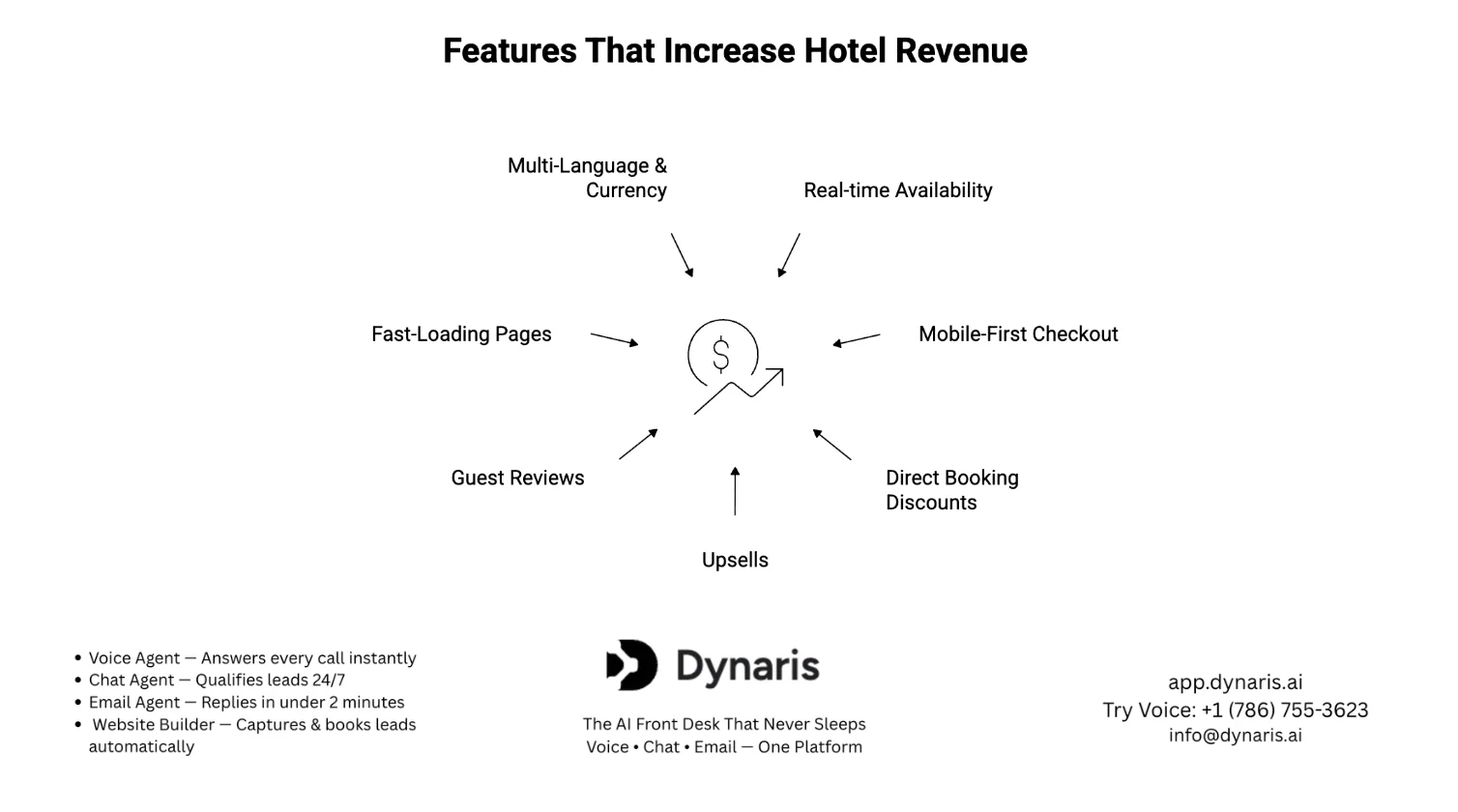
Hotel Website Features That Increase Direct Bookings
A high-performing hotel website builder should include features specifically designed to improve conversion rates and increase direct revenue.
Real-Time Availability and Clear Booking CTA
- Instant availability checks
- Prominent booking buttons on every page
- Clear pricing visibility
Guest Reviews and Social Proof
- Verified guest feedback
- Ratings and testimonials
- Integration with review platforms
Exclusive Direct Booking Perks
- Discounts for direct bookings
- Free upgrades or add-ons
- Special packages unavailable on OTAs
Local Guides and Area Content
- Nearby attractions and experiences
- Travel tips and recommendations
- Location-based landing pages for SEO
Fast Room Pages With Strong Visual Hierarchy
- Clear room descriptions
- High-quality visuals
- Easy comparison between room types
Multilingual and Multi-Currency Support
- Language options for international guests
- Localized pricing
- Region-specific content
Smart Offers, Packages, and Upsells
- Bundled experiences
- Seasonal promotions
- Add-ons like spa, dining, or tours
Mobile Checkout With Minimal Steps
- Simplified booking forms
- Fast checkout process
- Mobile-optimized payment flow
SEO Strategy for Hotel Websites in 2026
Ranking a hotel website today requires more than basic optimization. A modern hotel website builder must support advanced SEO strategies that align with how travelers search, compare, and decide.
Local SEO for Hotel Searches
Most hotel searches are location-driven and intent-rich. Optimize for modifiers such as:
- City and district names
- Nearby landmarks
- Airports
- Event venues
- Beaches or tourist attractions
- Business districts
Example intent patterns:
- hotels near airport with shuttle
- boutique hotel in downtown area
- beachfront stay near city
Your website should include location-specific pages that match these search patterns. This increases visibility for high-conversion queries.
Programmatic or Scaled Landing Pages
Hotels that scale content outperform competitors relying on a few static pages. Create targeted landing pages for:
- Room types (deluxe, suite, family rooms)
- Nearby attractions
- Wedding and event stays
- Business travel accommodations
- Pet-friendly stays
- Family-friendly packages
- Last-minute booking deals
Schema and SERP Visibility
Structured data improves how your website appears in search results. Key implementations include:
- Hotel schema for property details
- FAQ schema for common questions
- Review markup to display ratings
- Optimized images for faster indexing
AEO and Conversational Search Readiness
Search is shifting toward AI-driven and conversational queries. To stay competitive:
- Answer real traveler questions naturally
- Structure content for voice search
- Include comparison-style FAQs
- Write in a clear, direct, and helpful tone
Your hotel website builder should support flexible content creation that aligns with AI-generated summaries and answer-based results.
UGC and Social Proof as SEO-Assisted Trust Builders
User-generated content plays a growing role in both trust and discoverability.
- Embed authentic guest reviews
- Include creator-style room tours
- Showcase real guest experiences
- Align social content with search intent
How to Choose the Right Hotel Website Builder Step by Step
Selecting the right platform requires a structured approach based on your business needs and long-term goals.
Start With Your Business Model
Your choice depends heavily on how your hotel operates.
- Single property vs multi-property setup
- Luxury vs budget positioning
- Destination-driven vs business-travel-focused
Each model requires different levels of customization, integrations, and scalability.
Audit Your Operational Needs
Your website must align with your backend systems. Key considerations:
- PMS integration
- Payment processing setup
- Booking engine requirements
- Channel manager synchronization
- Multilingual support
Ignoring these factors leads to inefficiencies and operational issues.
Decide Your Growth Priorities
Not all hotels have the same priorities.
- Fast launch for immediate presence
- Strong branding for visual appeal
- Direct booking optimization
- SEO-driven long-term growth
- Scalability for expansion
Your hotel website builder should match your primary growth objective.
Think About Ownership in 2 Years, Not Just Setup in 2 Days
Many hotels choose platforms based on ease of setup rather than long-term control.
- Will you be able to scale your content?
- Can you migrate if needed?
- Do you own your data and customer relationships?
This long-term perspective is critical when selecting the right platform.
Final Verdict: Which Is the Top Hotel Website Builder?
The best choice depends on your goals, but some platforms clearly stand out in specific areas.
- Best Overall — Dynaris combines website building, booking, automation, and CRM into one system focused on direct bookings and growth.
- Best for Boutique Design — Squarespace or Webflow. Ideal for visually driven hotels that prioritize brand identity and storytelling.
- Best for SEO and Ownership — WordPress. Offers maximum control, flexibility, and long-term SEO potential.
- Best for Small Hotels — Wix or SITE123. Easy to use, affordable, and suitable for smaller operations.
- Best for Complex Operations — Hospitality-specific platforms or WordPress setups. Best for multi-property hotels and advanced operational needs.
- Best for Fast Launch — Wix or SITE123. Quick deployment with minimal technical requirements.
Conclusion
The best hotel website builder is not the one with the most templates or the easiest setup. It is the one that helps you increase direct bookings, reduce friction, and scale your business over time.best website builder for nonprofitFor another service-business perspective, see our guide on the best electrician website builder
Hotels that succeed online focus on:
- Seamless booking experiences
- Strong SEO and discoverability
- Clear communication and trust signals
- Long-term flexibility and ownership
Instead of choosing based on appearance alone, evaluate platforms based on performance, integration, and growth potential.
Next steps:
- Compare the platforms discussed in this guide
- Audit your current website for conversion gaps
- Shortlist builders based on your hotel type and goals
Making the right choice today can directly impact your revenue and competitive advantage in the years ahead.
Related: AI website builder, best drag and drop website builder, best electrician website builder, AI receptionist for small business.
For related reading, see our best wedding website builders article.