
Quick Summary: 806 Area Code
For related reading, see our 413 area code article.
- Covers a large and important region of Texas: The 806 area code serves the Texas Panhandle and South Plains, including major cities like Lubbock and Amarillo, along with dozens of smaller towns and rural communities.
- Operates in Central Time with consistent dialing rules: It follows Central Time (CST/CDT) and requires 10-digit dialing, making it aligned with standard communication practices across the United States.
- Strong regional identity and economic importance: The area is known for agriculture, energy, healthcare, and education, making 806 a key communication link for both urban hubs and rural industries.
- Boosts business trust and customer response rates: A local 806 number helps businesses appear more credible, increases call answer rates, and strengthens relationships with customers in West Texas.
- Useful for both business and personal purposes: Beyond business use, an 806 number can be used as a second phone number for privacy, online transactions, freelance work, or separating personal and professional communication.
For related reading, see our 940 area code article.
806 Area Code: Location, Time Zone & Coverage Overview
| Category | Details |
|---|---|
| Area Code | 806 |
| State | Texas, United States |
| Primary Region | Texas Panhandle and South Plains |
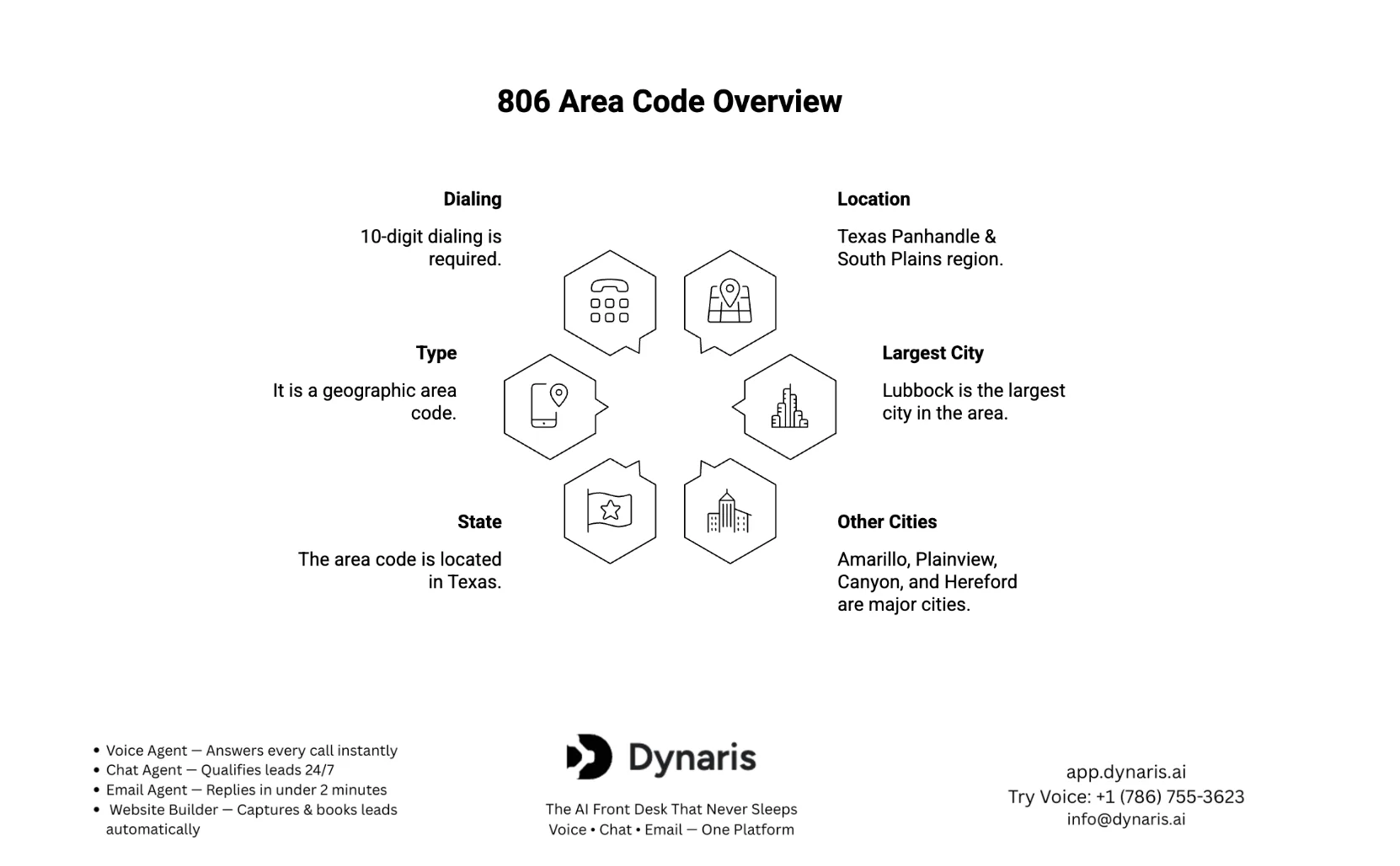
| Largest City Served | Lubbock |
| Other Major Cities | Amarillo, Plainview, Pampa, Hereford, Dumas, Canyon, Levelland, Borger, Brownfield, Perryton, Dalhart, Littlefield, Muleshoe, Tulia, Friona, Canadian, Floydada, Tahoka, Denver City |
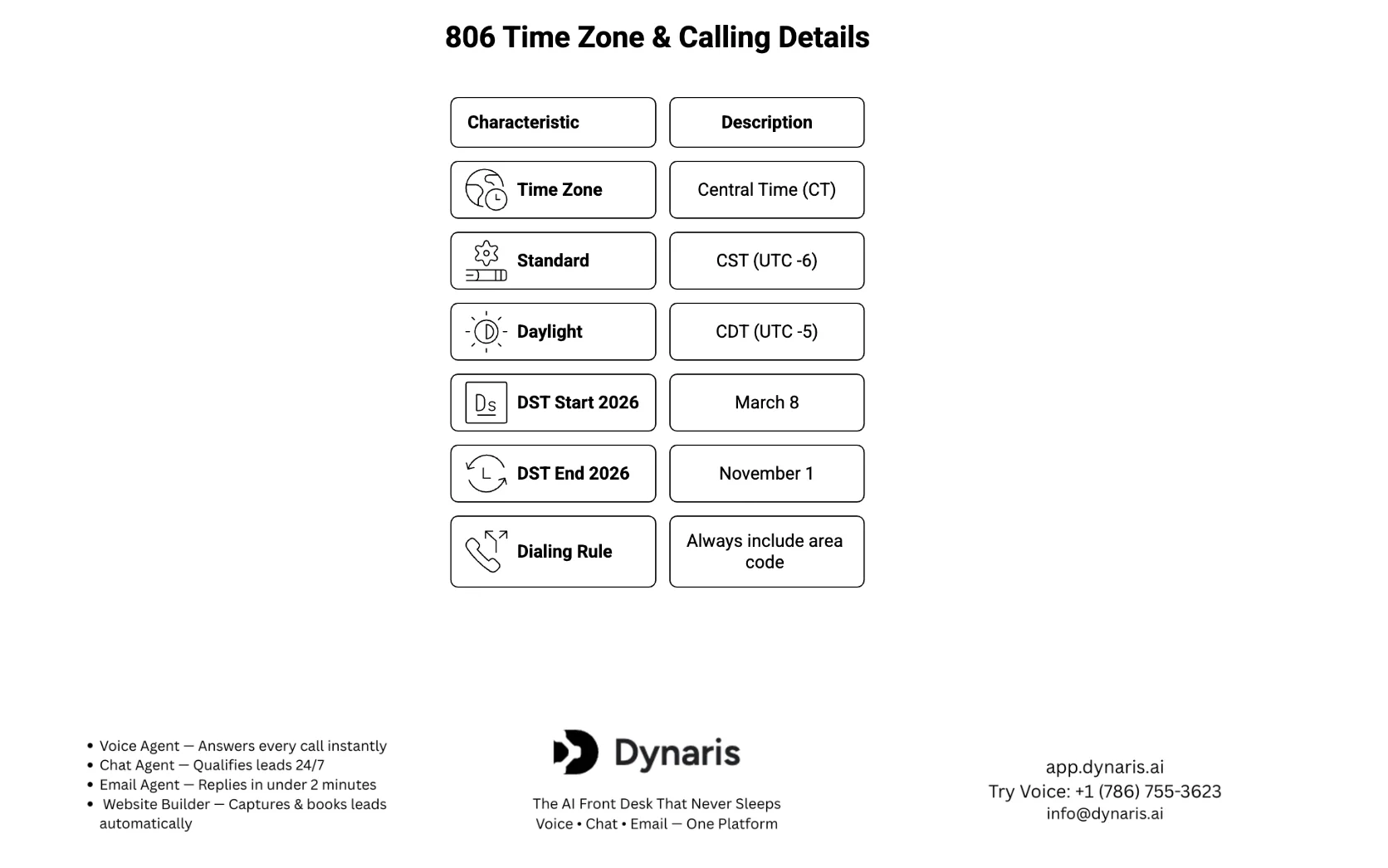
| Time Zone | Central Time (CT) |
| Standard Time | Central Standard Time (CST) |
| Daylight Saving Time | Central Daylight Time (CDT) |
| Standard UTC Offset | UTC/GMT –6:00 |
| Current DST Offset | UTC/GMT –5:00 |
| DST Start 2026 | Sunday, March 8, 2026, at 2:00 AM |
| DST End 2026 | Sunday, November 1, 2026, at 2:00 AM |
| 10-Digit Dialing | Required |
| Area Code Type | Geographic area code |
| General Coverage | Covers much of northwest Texas, especially communities across the Texas Panhandle and South Plains |
| Key Counties Served | Lubbock, Potter, Hale, Gray, Deaf Smith, Moore, Randall, Hockley, Hutchinson, Terry, Dawson, Ochiltree, Dallam, Lamb, Garza, Bailey, Yoakum, Swisher, Castro, Parmer, Hansford, Hemphill, Floyd, Gaines, Lynn, Carson, Collingsworth, Hall, Sherman, Wheeler, Donley, Crosby, Cochran, Lipscomb, Armstrong, Dickens, Cottle, Oldham, Briscoe, Roberts, Motley, Hartley, Kent, Borden, Stonewall |
| Well-Known Communities | Lubbock, Amarillo, Plainview, Pampa, Hereford, Dumas, Canyon, Levelland, Borger, Brownfield, Perryton, Dalhart, Littlefield, Post, Muleshoe, Denver City, Tulia, Friona, Spearman, Canadian, Floydada, Seagraves, Tahoka, Panhandle, Wellington, Clarendon, Morton, Booker, Claude, Paducah, Vega, Silverton, Miami, Matador, Hartley, Channing |
The 806 area code is more than a telephone prefix. In Texas, especially across the Panhandle and South Plains, it represents geography, local identity, business trust, and community familiarity. For residents, it is part of daily life. For new movers, it helps define the region. For business owners, it can be a practical tool for building credibility with local customers. And for individuals who want privacy, a separate 806 number can be useful for buying and selling online, freelance work, or temporary communication.
For related reading, see our 587 area code article.
For related reading, see our 607 area code article.
This guide explains everything you need to know about the 806 area code, including where it is located, which cities and counties it covers, what time zone it uses, why it matters to local businesses, how it is used for personal privacy, and how to stay safe from scam calls.
What Is the 806 Area Code?
The 806 area code is a telephone area code in the North American Numbering Plan serving a large part of northwestern Texas. It covers much of the Texas Panhandle and South Plains, including major centers such as Lubbock and Amarillo, along with many smaller cities, towns, and rural communities.
It is one of the best-known regional area codes in Texas because it serves a part of the state with a strong identity and a major role in agriculture, energy, transportation, education, and healthcare. Unlike some area codes that are associated mainly with a single metro area, 806 represents a broad and economically important region that includes both urban hubs and expansive rural land.
In practical terms, the 806 area code is used for residential lines, business numbers, local mobile numbers, institutions, healthcare facilities, and academic organizations throughout the region.
Where Is the 806 Area Code Located?
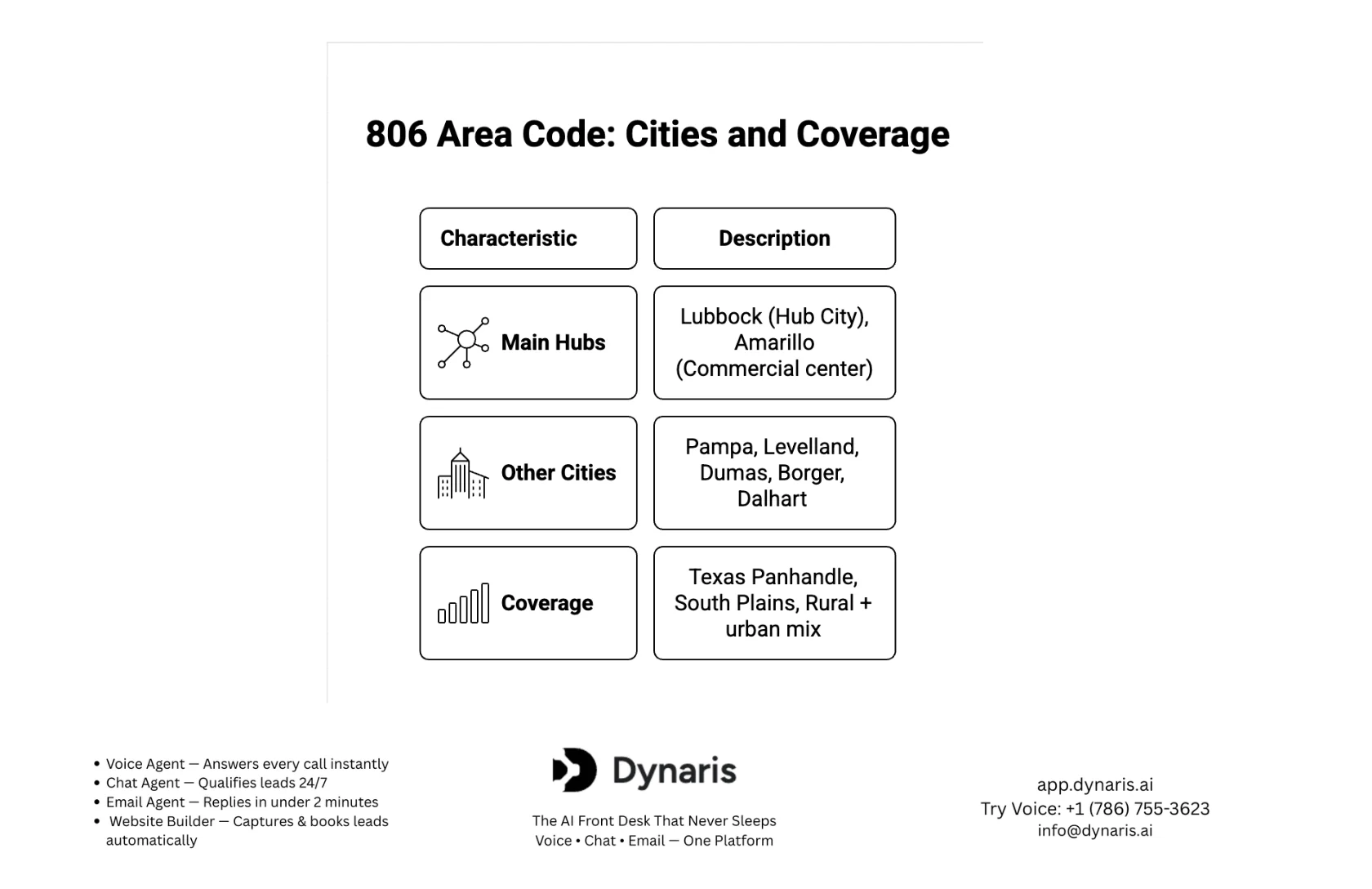
The 806 area code covers a wide section of northwestern Texas. It is most strongly associated with the Texas Panhandle and South Plains. This is a region known for open landscapes, agricultural production, cattle, cotton, wind energy, universities, and strong local community identity.
The area includes important cities such as Lubbock and Amarillo, but its footprint extends far beyond those two centers. It also serves a large network of smaller communities that are economically and socially tied to the region's larger hubs.
Major Cities Covered by 806
- Lubbock
- Amarillo
- Plainview
- Canyon
- Hereford
- Pampa
- Levelland
- Dumas
- Borger
- Dalhart
Counties Commonly Associated With 806
- Lubbock County
- Potter County
- Randall County
- Hale County
- Hockley County
- Gray County
- Deaf Smith County
- And many surrounding counties
It also extends into many surrounding counties and smaller communities, making it one of the more geographically broad local area codes in Texas.
Smaller Communities and Regional Reach
Part of what makes 806 distinctive is that it serves not only major city centers but also many smaller towns and rural communities. These places are important because they reflect the real nature of the region: not just cities, but a network of agricultural, industrial, educational, and service-based communities spread across a large geographic area.
That wide reach is one reason the 806 area code has such a strong regional identity. It belongs to an area that feels connected even when communities are physically far apart.
Nearby Area Codes to 806
- 325 – to the south
- 432 – in western Texas
- 575 – in New Mexico
- 580 – in Oklahoma
- 940 – in Texas
This matters for businesses that operate across state or regional boundaries. It also matters for people who receive calls from surrounding areas and want to understand whether those numbers are local, nearby, or from outside the immediate region.
806 Area Code Time Zone
The 806 area code is entirely in the Central Time Zone. That means:
- During standard time, it observes Central Standard Time (CST), which is UTC–6
- During daylight saving time, it observes Central Daylight Time (CDT), which is UTC–5
For most users, the main point is simple: if you are calling someone in the 806 area code, you should assume Central Time.
Why the Time Zone Matters
Knowing the time zone is important for anyone doing business in or communicating with the 806 region. Key considerations include:
- customer service scheduling
- appointment booking
- remote work coordination
- sales outreach
- healthcare communication
- logistics and dispatch planning
For local businesses, staying aligned with Central Time is essential because customers expect calls, responses, and service windows to match local business hours. For remote businesses serving West Texas, using a local 806 number works best when paired with an understanding of local time expectations.
History of the 806 Area Code
The 806 area code has a long and stable history tied closely to the development of West Texas. It was officially introduced in 1957 as part of the expansion of the North American Numbering Plan (NANP), which was created to organize and standardize telephone systems across the United States and neighboring countries.
Creation and Early Development
Before 1957, much of northwestern Texas was served by larger area codes, particularly 915 and parts of 817. As population, agriculture, and industry began to grow after World War II, the demand for telephone numbers increased. To manage this growth and improve communication efficiency, the region was split and assigned a new dedicated area code — 806.
From the beginning, the 806 area code was designed to cover a large geographic region rather than a single city, reflecting the dispersed population of the Texas Panhandle and South Plains. This included both urban centers like Lubbock and Amarillo and a wide network of smaller towns and rural communities.
Growth with Regional Industries
Throughout the 1960s, 1970s, and beyond, the 806 area code became closely associated with the economic backbone of West Texas. As agriculture expanded — particularly cotton farming and cattle ranching — reliable telephone communication became essential for trade, logistics, and coordination.
Later, the growth of oil, gas, and wind energy industries further increased the importance of communication infrastructure in the region. The presence of major institutions such as Texas Tech University in Lubbock also contributed to population growth and increased demand for telephone services.
Despite this growth, the region remained relatively spread out compared to major metropolitan areas, which helped keep the numbering demand manageable.
Stability Without Overlay Codes
One of the most notable aspects of the 806 area code is its stability. Unlike many area codes in rapidly growing urban areas, 806 has never required an overlay code. An overlay occurs when a new area code is introduced to serve the same geographic region due to number exhaustion.
The absence of an overlay means that 806 has maintained a clear and consistent identity for decades. Residents and businesses continue to use the same area code without needing to adapt to multiple overlapping codes, which is increasingly rare in modern telecommunications.
Transition to 10-Digit Dialing
In 2021, the region, like the rest of the United States, transitioned to mandatory 10-digit dialing. This change required callers to dial the area code even for local calls. The update was implemented nationwide to support the introduction of the 988 Suicide Prevention Lifeline, ensuring that three-digit dialing would not conflict with existing number formats.
While this change altered dialing habits, it did not affect the geographic boundaries or identity of the 806 area code itself.
Present-Day Significance
Today, the 806 area code remains a primary telecommunications identity for West Texas. It continues to serve:
- major cities like Lubbock and Amarillo
- regional healthcare and education systems
- agricultural and energy industries
- small businesses and local services
- residential and mobile users
Beyond its technical function, 806 has become a symbol of regional pride, often used in branding, local culture, and community identity across the Texas Panhandle and South Plains.
In a time when many area codes are split, overlaid, or constantly changing, the 806 area code stands out as a stable, recognizable, and deeply rooted part of West Texas history.
Why 806 Has Kept Its Identity
Unlike many fast-growing areas that eventually receive overlay codes, the 806 area code has remained a single-code region without an overlay. That gives it a cleaner and more recognizable local identity.
There are a few reasons this matters: First, it makes the code easier to associate with a specific region. Second, it helps maintain a sense of continuity. Third, it reinforces the idea that 806 belongs to a distinct geographic and cultural part of Texas rather than to a rapidly fragmented metropolitan numbering system.
The Economic Importance of the 806 Region
The 806 area code serves a region with a strong and diverse economic base. While many outsiders think of the Panhandle and South Plains only in agricultural terms, the region is broader and more economically varied than that.
Key Industries in the 806 Area
- Agriculture: The region is one of the most productive agricultural areas in the United States, with cotton, grain sorghum, wheat, and corn among the leading crops.
- Cotton Production: The South Plains around Lubbock is one of the largest cotton-growing regions in the world, contributing significantly to both state and national agricultural output.
- Cattle Ranching and Beef Processing: The Texas Panhandle, particularly around Amarillo, is a major hub for beef cattle production and processing, making it one of the top beef-producing regions in the U.S.
- Oil and Gas: The region sits atop significant hydrocarbon reserves, and oil and gas production remains an important economic driver for many communities.
- Wind Energy: West Texas has emerged as one of the leading wind energy production areas in the nation, with large wind farms spread across the Panhandle contributing to the state's energy grid.
- Healthcare: Major hospital systems and healthcare networks serve the region, with Lubbock functioning as a regional medical hub.
- Manufacturing: Food processing, equipment manufacturing, and other industrial activities support employment across the region.
- Transportation and Logistics: The region's role as an agricultural and energy production center means that trucking, rail, and logistics operations are highly active.
- Higher Education: Texas Tech University, West Texas A&M University, and several other institutions bring significant economic activity and a steady flow of students, faculty, and research investment to the region.
This mix of industries is one reason a local 806 number can carry real business value. It connects a company or professional to a region with active commerce, established institutions, and a large service area.
Lubbock and Amarillo as Regional Anchors
Lubbock and Amarillo play especially important roles.
Lubbock is often referred to as the Hub City. It is a major center for education, healthcare, agriculture, and business activity. Texas Tech University gives it additional economic and cultural weight, and the city serves as a hub for surrounding communities.
Amarillo is a major industrial and commercial center in the Panhandle. It is closely associated with cattle, beef, transportation, healthcare, and broader regional services. Its position makes it important not only within the 806 area but also in interstate trade and logistics.
Major Industries and Businesses That Benefit From an 806 Number
A local number is not equally valuable to every type of business. In the 806 region, some sectors benefit especially strongly from having a local phone presence.
Finance and Banking
Banks and lenders that serve agricultural producers, local businesses, and households can benefit from an 806 number because local trust matters in financial relationships. A familiar number can make outreach feel more credible and accessible.
Healthcare and Hospitals
Hospitals, clinics, specialty care providers, and health systems often serve patients from both city centers and rural counties. A local 806 number signals regional accessibility, which can be especially important in healthcare communication.
Logistics and Transportation
Because the region plays a role in freight movement and cross-regional transport, local communication matters for carriers, dispatch teams, warehouses, and service providers. A local number can support easier connection with customers and partners.
Education
Universities, colleges, training centers, and student-facing services benefit from local recognition. In a region where institutions like Texas Tech are major anchors, a local area code helps reinforce legitimacy and connection.
Insurance and Agricultural Services
Insurance providers, farm service businesses, crop-related companies, and livestock-related operations often depend heavily on local relationships. In those industries, a local number is not a minor branding detail. It can be part of how trust is formed.
Service Businesses and Local Trades
Local contractors, repair companies, home services, real estate offices, legal practices, and small business operators can all gain from the familiarity of a local 806 number. Customers often feel more comfortable answering and returning calls from a recognizable area code.
Why Local Numbers Build Trust
One of the strongest reasons businesses want an 806 number is simple: people trust local numbers more.
When a customer sees a local area code, several things happen psychologically. The call looks more relevant. It feels more familiar. It seems more likely to come from a local organization, service provider, clinic, school, or business.
That does not mean every local-looking call is legitimate. Scam callers also know this, which is why spoofing happens. But in normal business communication, local familiarity can still increase answer rates, callback rates, and initial engagement.
This is especially important for:
- small businesses
- clinics
- sales teams
- appointment-based services
- regional support centers
- multi-location businesses entering West Texas
The “806” Lifestyle and West Texas Identity
The 806 area code is also tied to local identity in a way that many area codes are not. In the Panhandle and South Plains, the number is often used as a shorthand for regional belonging.
People recognize it as part of the character of West Texas. It appears in casual local conversation, branding, social media references, and community culture. That identity dimension matters because it means the number carries emotional recognition, not just technical meaning.
What Makes the 806 Region Distinct
The region is known for:
- open landscapes
- strong western heritage
- practical local culture
- agriculture and ranching roots
- universities and medical institutions
- a blend of rural and urban life
This identity affects how people respond to local businesses, local communication, and area-code branding. A local number can feel like part of the community rather than just another business tool.
Things To Do in the 806 Region
For new residents, visitors, and businesses trying to understand the region better, the 806 area code is also tied to several well-known attractions and landmarks.
Palo Duro Canyon
Palo Duro Canyon is one of the most recognized attractions in the region. It is known for dramatic scenery, outdoor recreation, and its importance to the natural identity of the Texas Panhandle.
Cadillac Ranch
Cadillac Ranch is an iconic Amarillo-area landmark and one of the most recognizable cultural sites in the region. It adds character and tourism visibility to the local area.
Amarillo Botanical Gardens
This attraction adds another dimension to the region's identity and gives both locals and visitors something beyond the standard West Texas stereotypes.
Texas Tech University
Texas Tech is more than a university. It is one of the major anchors of culture, education, research, employment, and regional identity in Lubbock and beyond.
Including attractions and institutions like these in an article about the 806 area code makes the topic more useful because people often want more than technical phone information. They want to understand the place connected to the number.
Education and Universities in the 806 Region
Education is an important part of the 806 area's identity and economy. Major institutions in the region include:
- Texas Tech University
- West Texas A&M University
- Lubbock Christian University
- Texas Tech University Health Sciences Center
These institutions affect population patterns, workforce development, housing, healthcare, research, and local business activity. For many students, parents, staff, and service providers, the 806 area code is directly tied to educational life.
Business Benefits of Using an 806 Area Code Number
For businesses targeting customers in the Texas Panhandle and South Plains, having a local 806 number offers a range of tangible advantages. Here are the key benefits:
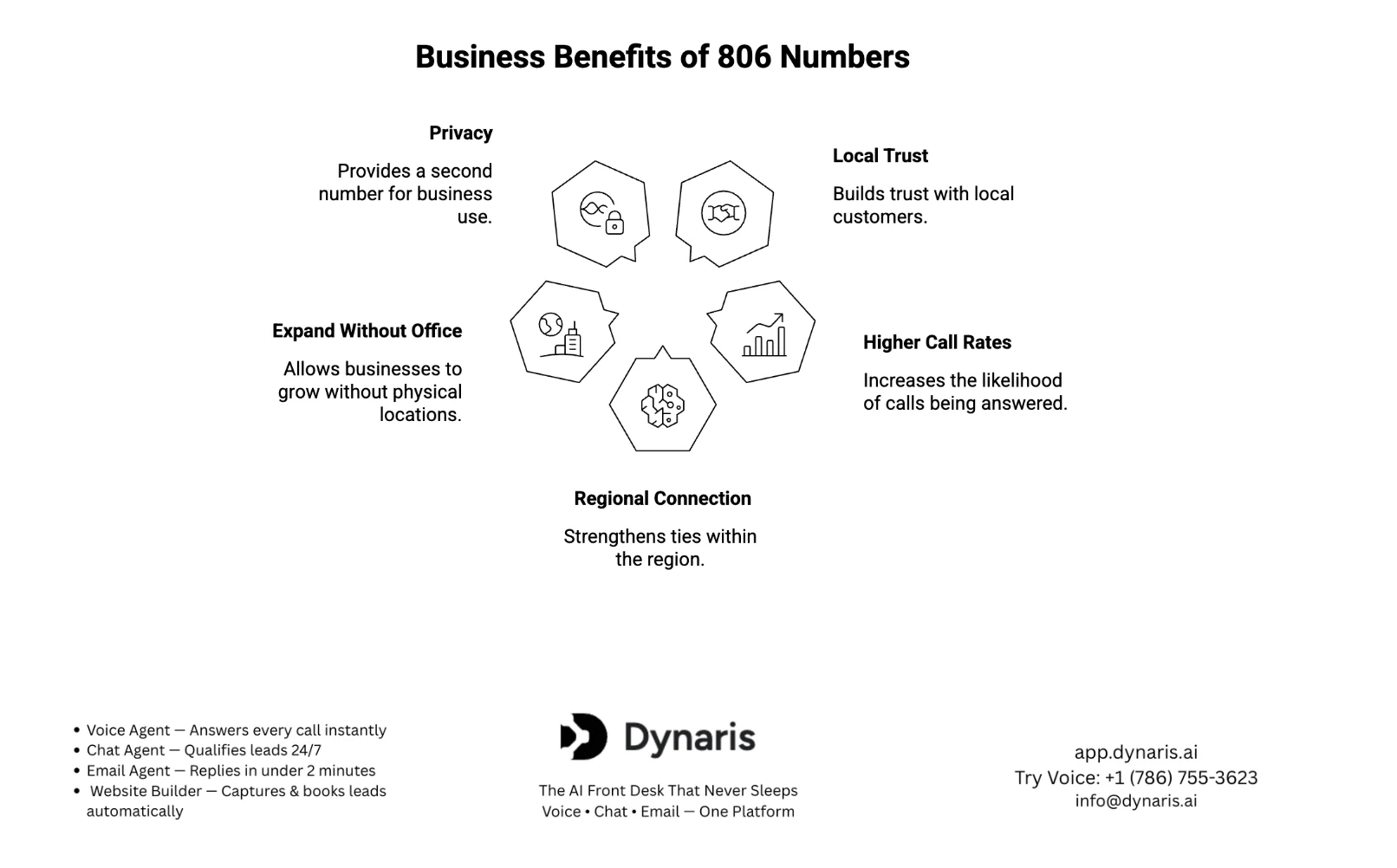
- Builds Immediate Local Trust and Credibility: When customers in West Texas see an 806 number on their caller ID, they immediately recognize it as a local call. This recognition reduces hesitation and increases the likelihood that the call will be answered.
- Higher Call Answer and Response Rates: Studies consistently show that calls from local area codes are answered at significantly higher rates than calls from out-of-state or toll-free numbers. For businesses making outbound calls, this alone can dramatically improve results.
- Stronger Connection With the Local Market: A local number communicates that your business is present in the community and understands local needs. This is especially important in relationship- driven industries like agriculture, healthcare, and real estate.
- Ideal for Regional Expansion Without Physical Presence: Businesses located outside the 806 region that want to serve West Texas customers can use a local 806 number to establish a regional presence without opening a physical office.
- Improves Marketing and Brand Recall: A local area code is easier for customers to remember and associate with a specific region. For businesses running regional marketing campaigns, a local number reinforces the local angle of their messaging.
- Supports Better Customer Experience: Customers who need to follow up or call back are more comfortable dialing a local number they recognize, leading to better overall customer satisfaction.
- Enables Scalable Communication for Growing Businesses: With VoIP and cloud-based phone systems, businesses can add 806 numbers quickly, route them to any device or team, and manage them centrally as the business grows.
- Keeps Business and Personal Communication Separate: Using a dedicated 806 business number allows owners and employees to maintain a clear boundary between personal and professional communication.
- Cost-Effective Alternative to Traditional Phone Systems: Modern VoIP providers offer 806 numbers at a fraction of the cost of traditional landline systems, with no hardware requirements and flexible plans.
- Enhances Local SEO and Regional Presence: Having a consistent local phone number in business listings, Google Business Profile, and directories helps with local search engine optimization and improves regional visibility.
- Useful Across Multiple Industries: From healthcare and agriculture to real estate, education, and retail, virtually any business serving the West Texas region can benefit from a local 806 number.
Benefits of Using a VoIP or AI-Based Provider
Businesses that pair their 806 number with a modern VoIP or AI-powered provider like Dynaris gain additional capabilities:
- 24/7 Availability: AI-powered answering systems ensure that calls are handled around the clock, even outside business hours.
- Call Forwarding and Routing: Calls can be routed to the right person or department automatically.
- AI Answering and Automation: Routine inquiries, appointment scheduling, and lead capture can be handled automatically without human intervention.
- Scalability: Add or remove numbers and lines as the business grows.
- Cost Efficiency: Reduce overhead by replacing traditional phone systems with cloud-based solutions.
Business Phone Features That Matter Most
If you are getting an 806 number for business, some features matter more than others. The most useful include:
- call forwarding
- voicemail
- caller ID
- call logs
- call recording
- auto-attendant
- business hours settings
- extensions
- mobile and desktop access
- routing rules
These features improve customer experience because they reduce missed calls, make responses more consistent, and help businesses manage communication professionally.
Pricing for an 806 Number
Pricing varies by provider and by features. The cost usually depends on:
- whether the number is for personal or business use
- the number of users
- call volume
- texting support
- voicemail and routing features
- AI answering or automation
- monthly versus annual billing
Basic plans may be relatively simple and affordable, while advanced business plans cost more because they include more features and team support. The best approach is to compare what is included rather than looking only at the base price.
Porting an Existing 806 Number
If you already have an 806 number, you may not need to give it up when switching providers.
What Number Porting Means
Porting means moving your number from one provider to another while keeping the same number.
Why Businesses Port Numbers
Businesses often port numbers because they want:
- better features
- improved support
- lower costs
- AI tools
- easier team communication
- continuity for existing customers
Keeping the same number avoids confusion and helps preserve brand familiarity.
806 Local Number vs Toll-Free vs Out-of-State Number
When choosing a business number, many people compare local numbers with toll-free numbers or out-of-state numbers.
Local 806 Number
A local 806 number is best when trust, familiarity, and regional connection matter. It often performs well for local service businesses, healthcare, regional sales, and community-based organizations.
Toll-Free Number
A toll-free number can look more national and standardized. It may work well for larger brands or businesses serving broad markets. However, it can feel less local and less personal.
Out-of-State Number
An out-of-state number may be fine for some remote businesses, but it usually lacks the local trust advantage of an 806 number when targeting West Texas customers.
In many cases, the strongest approach for regional business communication is a local number, especially in markets where community trust matters.
Common Mistakes To Avoid
When choosing or using an 806 number, people often make avoidable mistakes.
One common mistake is picking a provider based only on price. Cheap service is not useful if call quality is poor or support is weak.
Another mistake is failing to separate personal and business communication. Mixing both on one number can create confusion and reduce professionalism.
Some businesses also overlook routing, voicemail, and business hours setup. A local number alone is not enough. The communication experience around it matters too.
Finally, many people assume that a local-looking 806 call must be legitimate. Because spoofing exists, local appearance should never be treated as proof.
806 Area Code Scams and Phone Safety
Like many local area codes, 806 is sometimes used in scam and spoofing activity. This does not mean the area code itself is suspicious. It means scammers know that local-looking numbers are more likely to be answered.
Common Scam Types
The most common risks include:
- spoofed local numbers
- fake law enforcement or official calls
- robocalls
- one-ring scams
- fake billing or payment requests
Why Local Spoofing Works
Spoofing works because familiarity creates trust. If a call appears to come from a number with an 806 area code, a local resident may assume it is from a nearby business, school, hospital, neighbor, or service provider.
That false sense of local familiarity is exactly what scammers try to exploit.
How To Protect Yourself
To stay safe:
- do not trust caller ID alone
- do not send money based on phone threats
- do not share sensitive information unless you independently verify the caller
- call official organizations back using their public contact details
- be cautious with missed-call callbacks from unknown numbers
For businesses, call filtering and structured call handling tools can also reduce the risk of wasted time on unwanted calls.
Personal Use Cases for an 806 Number
Most area-code articles focus only on business use, but personal use matters too. A separate 806 number can be useful for privacy, flexibility, and convenience.
Second Phone Number for Privacy
Many people want a separate number without carrying a second phone. A virtual 806 number can help keep a primary personal number private while still allowing calls and texts.
Online Buying and Selling
If someone uses online marketplaces or local sale platforms, a separate number can help reduce privacy risks. It allows communication with buyers and sellers without exposing a main personal number.
Dating Communication
Some people prefer using a separate number in early-stage dating or online introductions. This adds a layer of privacy and control.
Freelancers and Side Hustles
Freelancers, consultants, and people running side businesses often want to keep client communication separate from personal life. A local 806 number can support that separation while also reinforcing local presence.
Why Individuals Might Prefer a Local 806 Number
For personal users in West Texas, a local number can feel more natural than using a non-local second number. For people who have moved to the area, it can help them fit local expectations more quickly. For those using a number for temporary communication, it can also make interactions feel more relevant and familiar to local contacts.
How To Get an 806 Area Code Number
Getting an 806 number today is usually much easier than people assume. In most cases, the process is done through a cloud phone or virtual number provider.
- Step 1: Sign Up With a Provider
Choose a service that offers local numbers and create an account. - Step 2: Choose a Plan
Pick a plan based on your needs. Some people need only basic calling and texting. Others need business features like voicemail, forwarding, call routing, or AI answering. - Step 3: Complete Verification if Required
Some providers require identity or compliance steps before activation. - Step 4: Select an Available 806 Number
Once your account is ready, you can browse available local numbers and choose the one you want. - Step 5: Configure Your Setup
Depending on the provider, you may be able to customize: voicemail greetings, business hours, forwarding, caller ID, call routing, extensions, and auto-attendant settings. - Step 6: Go Live
After setup, you can usually begin using the number on a mobile phone, laptop, desktop app, or other connected device.
What To Look for in an 806 Number Provider
Not every provider is equally good. Before choosing one, it is smart to compare:
- availability of 806 numbers
- ease of setup
- call quality
- voicemail and forwarding features
- business hours controls
- support quality
- number portability
- pricing structure
- AI receptionist or automation options if needed
The right choice depends on whether your goal is business growth, privacy, temporary use, or team communication.
Providers like Dynaris offer 806 area code numbers alongside AI-powered call handling features that ensure every call is answered, every lead is captured, and every customer interaction is handled professionally—24 hours a day, 7 days a week.
Pricing for an 806 Number
The cost of obtaining and maintaining an 806 area code number varies depending on the type of provider and plan you select. Here is a general overview of what to expect:
- Basic VoIP number: Starting at a few dollars per month for a simple second number with calling and texting capabilities.
- Business phone system: Monthly plans typically range from entry-level options for small businesses to more comprehensive plans for larger teams with multiple lines and advanced features.
- AI-powered business communication: Providers that include AI answering, automated scheduling, CRM integration, and 24/7 call handling may charge a higher monthly fee, but the return on investment from improved lead capture and customer service typically justifies the cost.
- Number porting fees: Transferring an existing number to a new provider may involve a one- time porting fee, though many providers waive this as part of promotional offers.
Related: AI receptionist for small business, AI phone answering services guide.
For related reading, see our 403 area code article.