

Quick Summary
- A good business review should be honest, detailed, and specific rather than short or generic. Mention what service or product you used, what stood out, and whether you would recommend the business to others.
- The best reviews follow a simple structure: explain your experience, describe key positives or negatives, share the final outcome, and end with a recommendation. This makes the review easier to read and more trustworthy.
- Specific details increase credibility and usefulness. Instead of saying “great service,” explain what actually happened — such as fast delivery, responsive customer support, professional staff behavior, or product quality.
- Negative reviews should remain professional and constructive. Focus on facts, explain the issue clearly, and indicate whether the business attempted to resolve the problem, rather than using emotional or offensive language.
- Online reviews influence customer trust, local SEO rankings, and business reputation. Platforms like Google Reviews and Trustpilot use customer feedback as an important ranking and credibility factor.
What Makes a Good Business Review?
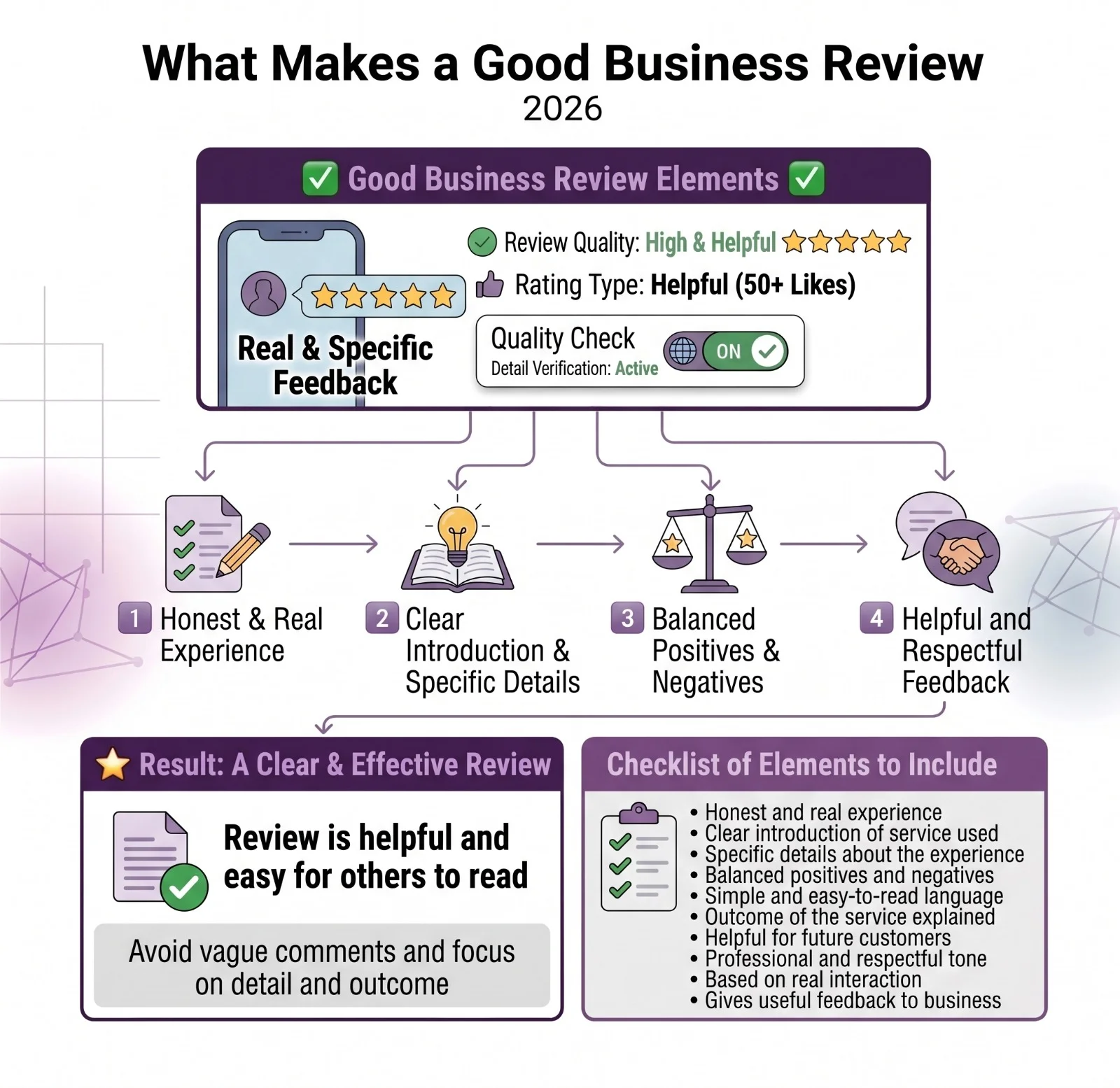
A strong review is more than just giving stars. It explains the customer's experience clearly and authentically.
A good review usually includes:
1. A Clear Description of Your Experience
Mention what service or product you used and what stood out.
Example:
“I visited this café for breakfast and was impressed by both the food quality and the friendly staff.”
2. Specific Details
Specific details make your review more trustworthy and useful.
You can mention:
- Customer service
- Product quality
- Delivery speed
- Cleanliness
- Pricing
- Staff behavior
- Problem resolution
Example:
“The team responded to my inquiry within 15 minutes and resolved the issue the same day.”
3. Honesty and Balance
Be honest about your experience. Even if you had a negative experience, stay respectful and objective.
Instead of:
“Worst company ever.”
Try:
“The delivery arrived two days late, but customer support apologized and offered a discount for the inconvenience.”
4. Helpful Recommendations
Tell future customers who the business may be best for.
Example:
“I'd definitely recommend this gym to beginners because the trainers are very supportive.”
Tips for Writing Better Business Reviews
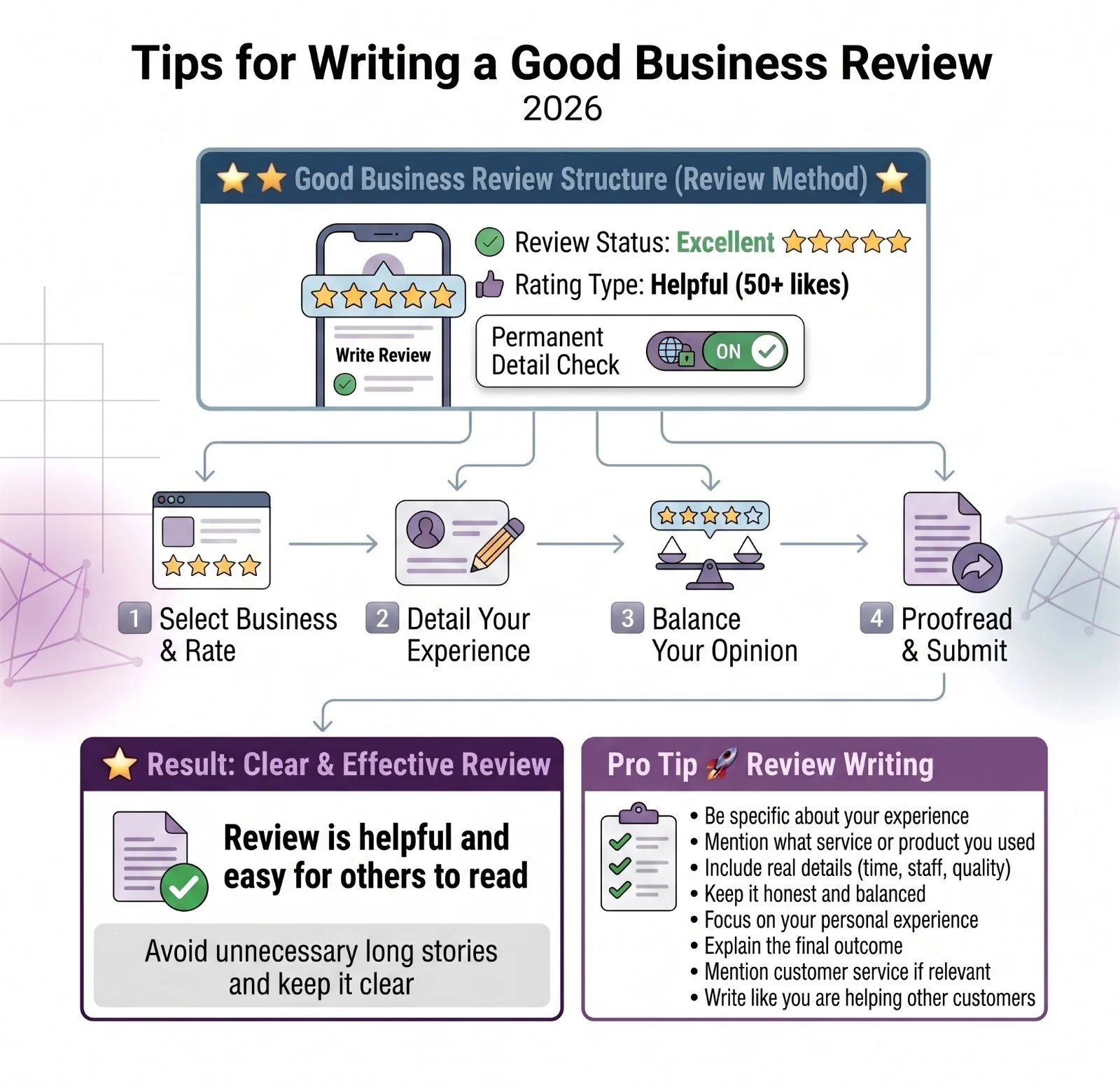
- Be specific — Mention what service or product you used and what stood out about the experience.
- Include real details — Talk about delivery time, staff behavior, pricing, communication, or product quality to make your review more trustworthy.
- Keep it honest and balanced — Mention both positives and negatives if applicable, instead of sounding overly promotional.
- Write clearly and professionally — Avoid emotional language, insults, or exaggerated claims.
- Focus on your personal experience — Authentic reviews are more helpful than generic statements.
- Explain the outcome — Share whether the business solved your problem or met your expectations.
- Mention customer service — Readers often care about how businesses handle communication and support.
- Keep it concise — A clear and focused review is more effective than a long, unfocused paragraph.
- Avoid vague phrases — Instead of “great service,” explain why the service was great.
- Update reviews when needed — If a business resolves your issue later, updating your review adds credibility and fairness.
Where You Can Leave Business Reviews
Popular platforms include:
Common Mistakes to Avoid When Writing a Business Review
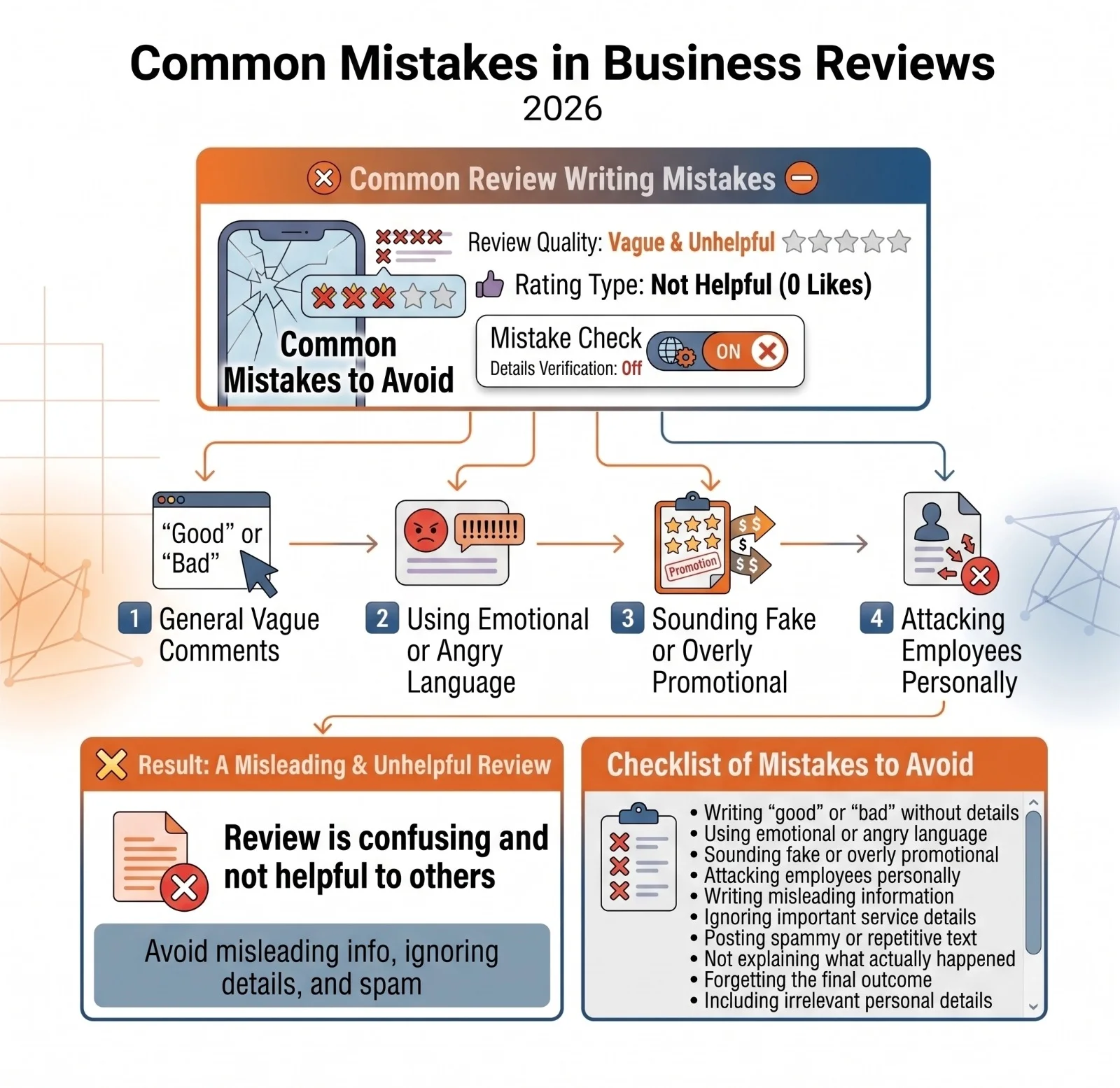
- Writing Reviews That Are Too Short: Reviews like “Great service” provide little value without context or details.
- Using Emotional or Aggressive Language: Angry or overly emotional reviews often appear less credible and unprofessional.
- Sounding Fake or Overly Promotional: Excessive praise and unrealistic claims can make a review look dishonest.
- Giving Criticism Without Context: Explain what went wrong instead of leaving vague complaints.
- Including Irrelevant Information: Stay focused on the actual business experience and avoid unnecessary details.
- Attacking Employees Personally: Review the service or experience, not someone's personality or appearance.
- Writing Misleading Information: Honest and accurate reviews are more trustworthy and helpful to readers.
- Ignoring Important Details: Mention factors like communication, pricing, service quality, or delivery time.
- Posting Spammy or Keyword-Stuffed Reviews: Repetitive or unnatural wording reduces authenticity and readability.
- Leaving Out the Final Outcome: Explain whether the business solved your problem or met your expectations.
The Psychology Behind Great Reviews
Good reviews are persuasive because they reduce uncertainty.
When reading reviews, people look for:
- Real experiences
- Emotional reassurance
- Evidence
- Consistency
- Social proof
Reviews that include emotions and outcomes often perform best.
Example:
“I was nervous about hiring an SEO agency, but their communication and transparency immediately made me feel confident.”
This creates emotional trust.
Great Review Examples for Different Businesses
Positive Restaurant Review Example
“Excellent dining experience from start to finish. The restaurant atmosphere was warm and welcoming, and the staff was attentive without being intrusive. The food arrived quickly and tasted fresh and flavorful. I especially enjoyed the grilled salmon and homemade desserts. Prices were reasonable considering the quality. I'll definitely be returning.”
Positive Hotel Review Example
“The hotel exceeded my expectations. Check-in was fast, the room was spotless, and the staff was extremely helpful throughout my stay. The location was convenient and close to major attractions. Breakfast options were excellent, and housekeeping maintained the room perfectly each day. Highly recommended for both business and family travel.”
Better Negative Review Example
“My order arrived three days later than promised, which was frustrating because it was a birthday gift. However, customer support responded quickly and refunded the shipping fee. I appreciate the effort to resolve the issue, though delivery communication could be improved.”
Next step: scope a custom build with Dynaris
Dynaris is a boutique custom software and intelligent automation studio. We design and build production voice agents, workflow automation, CRM integrations, and revenue operations systems — scoped as fixed-price engagements, not off-the-shelf SaaS subscriptions.
Typical v1 builds start at $25,000. We begin with a preliminary conversation to confirm fit, then a paid Discovery Sprint before any fixed-price build milestones.
Book a preliminary conversation — we map your review and reputation workflow, manual labor cost, and whether a Discovery Sprint is the right next step. See our process and engagement pricing for ranges.