

Quick Summary
- A good product review is based on real experience and focuses on helping readers make informed buying decisions rather than just promoting a product. It should clearly explain how the product performs in real-world usage and whether it delivers value.
- Strong reviews always include a balanced view of pros and cons. This builds trust and shows that the review is honest instead of biased or overly promotional, which improves credibility with readers and search engines.
- Specific details matter more than general opinions. Mentioning features like performance, usability, durability, or results makes the review more useful and improves its chances of ranking in search engines.
- SEO-friendly product reviews use structured formatting, relevant keywords, and clear headings. This helps search engines understand the content and increases visibility in organic search results.
- A strong conclusion or verdict is essential. It should clearly state who should buy the product, who should avoid it, and why, making it easier for readers to decide quickly.
What Makes a Product Review “Good”?
A good product review does three things: it is specific, credible, and useful to the next buyer. Star ratings alone fail all three tests.
The anatomy of a strong review:
- Context — Who is the reviewer and how did they use the product? (“I bought this for daily commuting on a hybrid bike…”)
- Specifics — What exactly stood out? (“The grip didn't loosen after 6 weeks of rain.”)
- Verdict — Would they buy it again, and for whom? (“Perfect for casual riders, probably overkill for pros.”)
- Balanced honesty — A minor caveat actually increases trust. All-positive reviews read as fake.
A review missing even one of these elements loses persuasive power. The goal isn't a glowing endorsement — it's a useful one.
Good Product Review Examples by Format
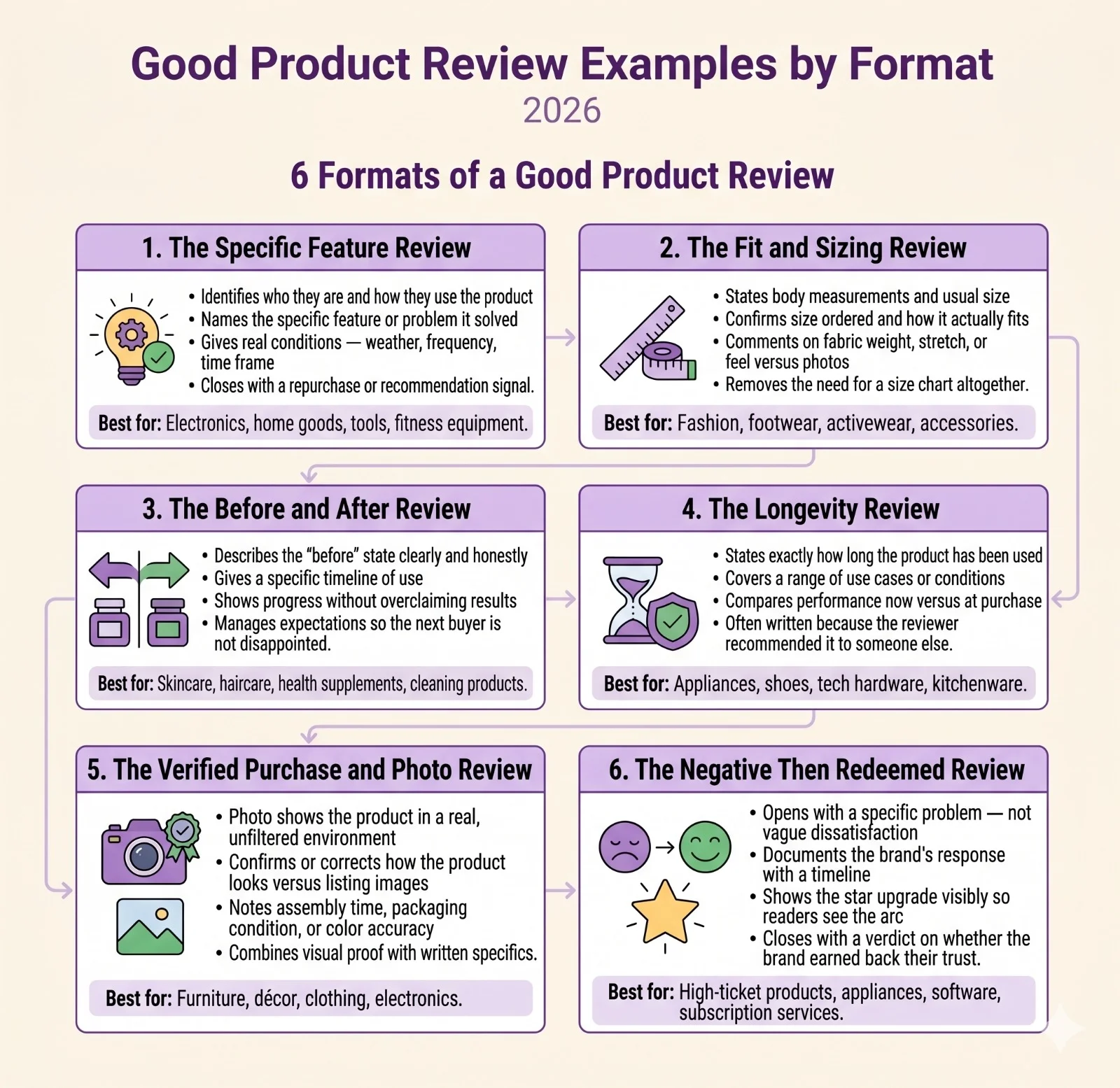
1. The Specific Feature Review
The most common and most effective format. The reviewer picks one or two concrete product attributes and speaks to them directly.
Example — skincare product:
“I have combination skin that breaks out with most SPFs. This one went on matte, didn't clog anything, and I wore it under foundation all day in 90°F heat. Zero greasiness. I've repurchased twice.”
Why it works:
- Identifies skin type (relevant context for other buyers)
- Describes a specific fear (breakouts from SPF) and directly resolves it
- Gives a time frame and real conditions
- The repurchase is the strongest possible signal
2. The Fit & Sizing Review (Apparel)
Size uncertainty is the #1 reason for cart abandonment in fashion. Reviews that address it directly eliminate the biggest friction point.
Example — online clothing store:
“I'm 5'7", 145 lbs, usually a medium in everything. Ordered a medium here — fits perfectly through the shoulders, slightly relaxed in the waist (which I prefer). The fabric is thicker than I expected from the photos, in a good way.”
Why it works:
- Gives body stats and usual size — directly comparable data for other shoppers
- Addresses both fit and fabric (two major unknowns in online apparel)
- The “thicker than expected” detail is honest and adds credibility
Brands like Thigh Society have built entire review systems around this: prompting reviewers to share their usual pant size and the size they actually purchased, making every review a sizing reference.
3. The Before/After Review
Particularly powerful for health, beauty, cleaning, and home products. It frames the product as a solution, not just a purchase.
Example — hair treatment:
“Three months of bleaching left my hair snapping off at the mid-length. After four weeks of this mask (twice a week), I can run a brush through my hair without hearing breakage. Still not fully recovered, but the difference is visible.”
Why it works:
- Sets up a clear “before” state
- Gives a specific timeline (four weeks, twice a week)
- Manages expectations honestly — doesn't claim a miracle
- Progress, not perfection, is more believable and more persuasive
4. The Longevity Review
Short-term reviews are easy. Longevity reviews are rare and therefore highly trusted.
Example — kitchen appliance:
“I bought this blender in 2021 and use it every morning. The motor hasn't slowed, the seals haven't cracked, and the blades still look new. I've blended everything from ice to frozen fruit to soups. I'm writing this review now because I recommended it to my sister and realized I'd never left one myself.”
Why it works:
- Three-plus years of real-world use speak louder than any product description
- Covers a wide variety of use cases
- The backstory (recommending to a sibling) signals genuine enthusiasm
- No incentive involved — clearly organic
5. The Verified Purchase + Photo Review
Adding a photo or video to a review significantly increases its persuasive impact because it proves the product actually arrived, looks like the listing, and works.
Example — furniture brand:
“Here's the chair in my actual apartment (photos attached). Ignore the lifestyle shots on the listing — the color in person is slightly more muted, which I actually prefer. The assembly took 20 minutes. My only note: the instructions are confusing at step 4. Figure it out, and you're fine.”
Why it works:
- The photo closes the “will it look different in real life?” gap
- Honest correction of the product listing (muted color) is a trust signal
- The assembly critique is specific and useful without being a dealbreaker
Brands like IKEA have formalized this by letting customers rate individual product dimensions — value, appearance, quality, ease of assembly — separately rather than lumping everything into one score.
6. The Negative-Then-Redeemed Review
A review that starts with a problem but ends with resolution is one of the most powerful trust signals a product page can have. It shows both product quality and brand responsiveness.
Example — electronics:
“The first unit arrived with a dead pixel on the screen. I contacted support and had a replacement shipped within 48 hours, no questions asked. The replacement has been perfect for five months. Upgraded from 3 stars to 5.”
Why it works:
- Shows the brand handles problems well
- The star upgrade is visible proof of resolution
- Prospects worried about “what if something goes wrong” get a direct answer
Good Product Review Examples by Industry
E-commerce / Physical Products
Focus on: materials, dimensions, packaging condition, color accuracy, and delivery speed.
“The ceramic mug arrived double-boxed with zero damage. The glaze is exactly the dark green shown — no brown undertones. Heavy in a satisfying way. Holds heat longer than my old mug from a big-box store.”
Software / SaaS
Focus on: specific features used, team size, workflow integration, and before/after efficiency.
“We switched our 12-person team from spreadsheets to this tool in January. Onboarding took a week. Now we close invoices in half the time. The reporting dashboard alone saved us hours a month in manual reconciliation.”
Hospitality / Travel
Focus on: location accuracy, cleanliness, noise level, staff responsiveness, and value relative to price.
“Third time staying here. The room was quieter than on previous visits (they fixed the HVAC). Breakfast buffet added since last year — genuinely good. 15-minute walk to the main sites. The city views from floor 8+ are worth requesting specifically.”
Healthcare / Services
Focus on: wait time, staff manner, clarity of communication, and follow-up.
“The intake process was faster than any clinic I've visited. Dr. Reyes explained every step before doing it and didn't rush the appointment. Got my results in 24 hours with a clear summary. Brought my husband back the following month.”
How Top Brands Display Product Reviews Well
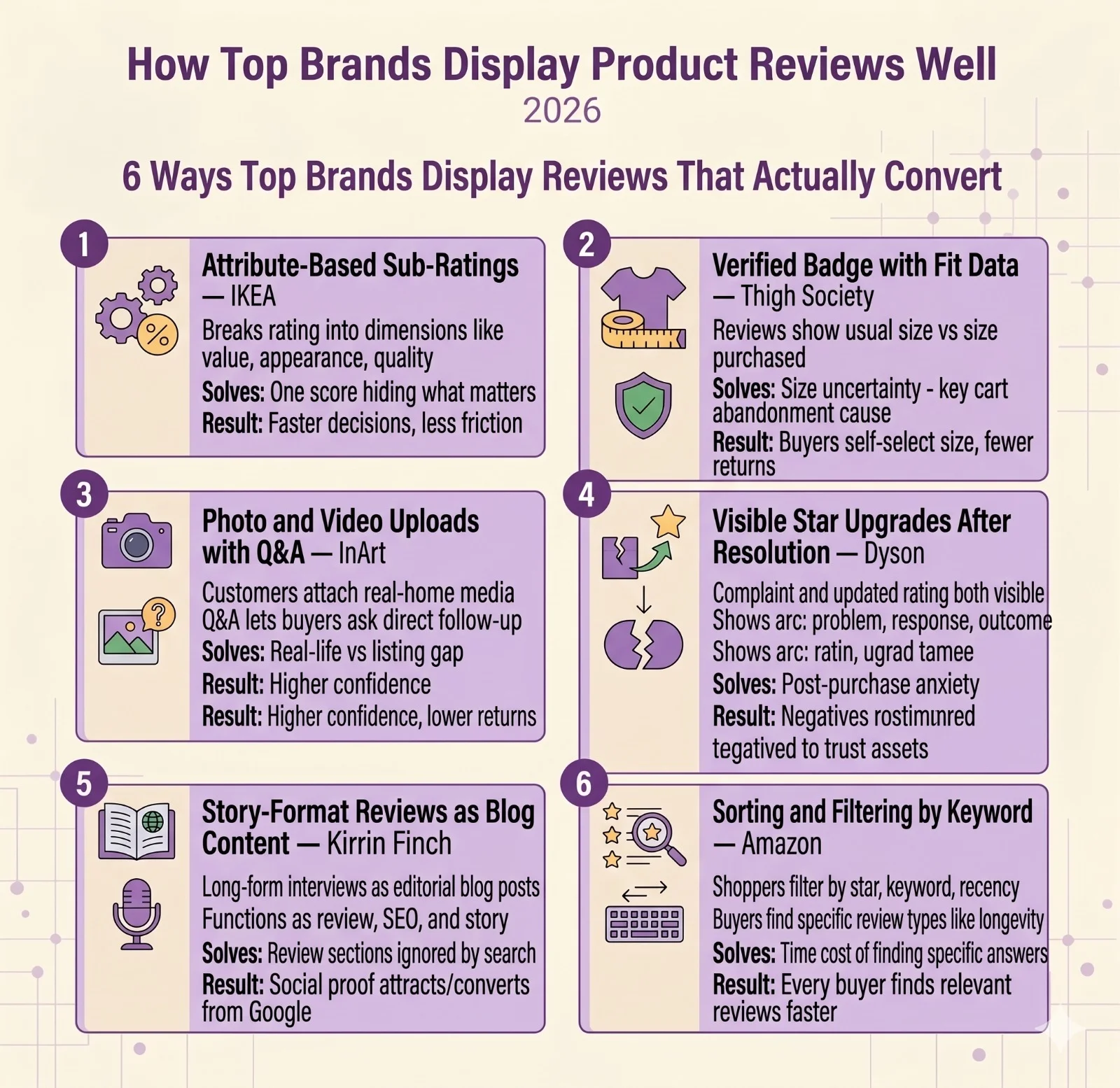
Writing a good review is only half the equation. How brands display reviews matters just as much.
What works:
- Attribute-based ratings — Rather than one overall score, breaking the rating into sub-categories (quality, value, ease of use, fit) gives shoppers exactly what they need. IKEA does this with adjustable criteria per product type.
- Verified purchase badges — A small visual indicator that the reviewer actually bought the product. Thigh Society uses this prominently to differentiate genuine feedback from brand noise.
- Photo/video uploads — Letting reviewers attach media transforms a review section into a real-world gallery. IKEA and InArt both enable this, with InArt also adding a Q&A widget that lets potential buyers ask follow-up questions directly.
- Sorting and filtering — Letting shoppers filter by rating, recency, or attribute (e.g., “show only reviews mentioning sizing”) removes friction.
- Story-format reviews — Kirrin Finch publishes long-form customer wedding stories as blog posts. They function as immersive, brand-aligned reviews that attract and convert cold traffic from search.
What Separates a Good Product Review from a Great One
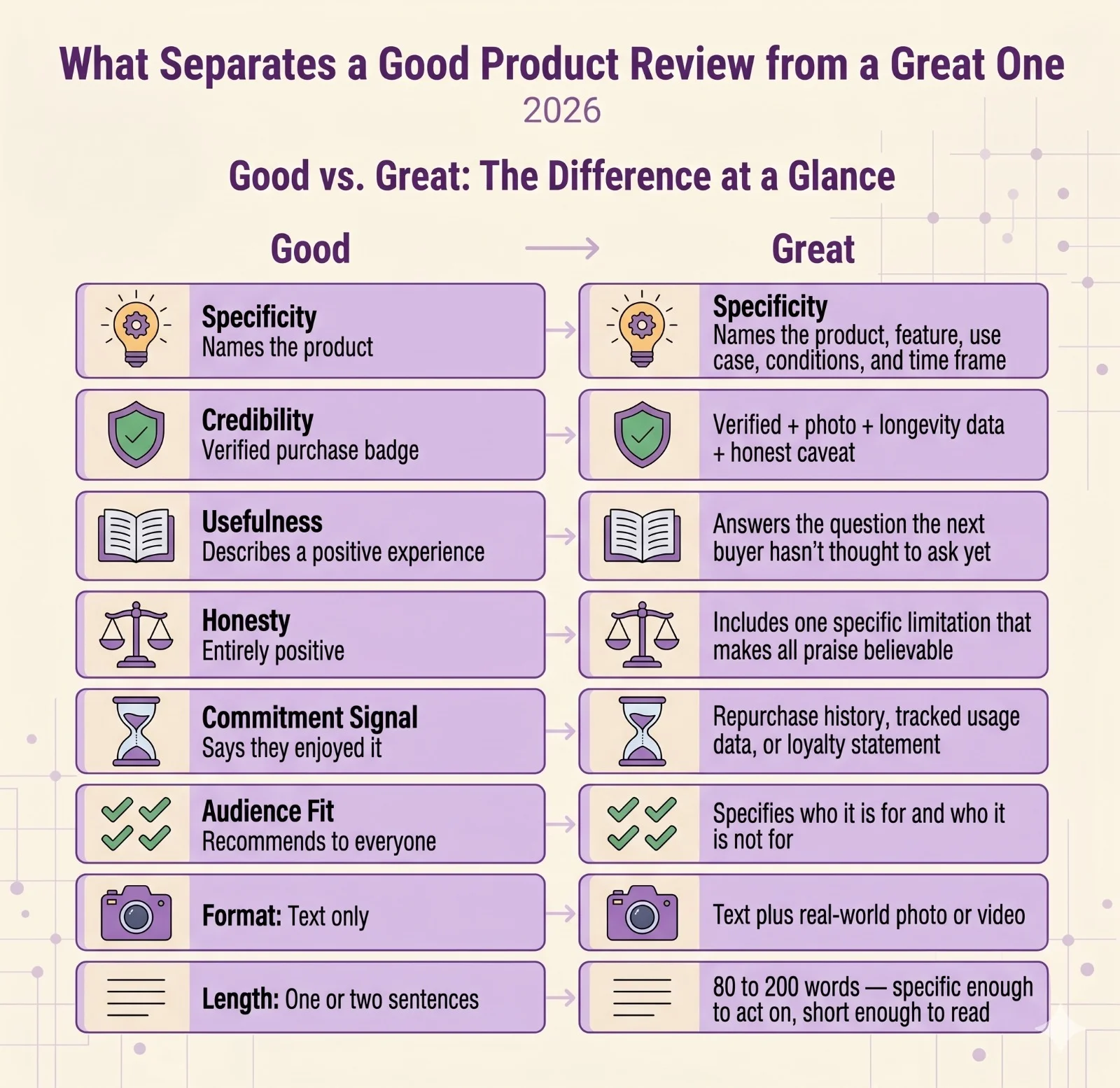
| Element | Good Review | Great Review |
|---|---|---|
| Specificity | Names the product | Names the product, feature, and context |
| Credibility | Verified purchase | Verified + photo + long-term use |
| Usefulness | Positive experience | Answers the question the next buyer has |
| Honesty | All positive | Includes a small caveat or comparison |
| Format | Text only | Text + image or video |
Real Examples of Good Product Reviews (Actual Brands, Real Products)
Reading about what makes a good review is one thing. Seeing it on a real product from a brand you recognize is another. Here are five examples pulled from actual product pages — each one dissected so you can see exactly what's working.
1. Amazon — Anker Nano II 65W USB-C Charger
Platform: Amazon.com | Category: Electronics | Rating: ⭐⭐⭐⭐⭐
Review title: “Finally replaced my 3-pound Dell brick”
“I travel for work every week. My old laptop charger was massive and I kept forgetting it at hotels. This thing is the size of a phone charger cube — fits in my laptop bag's front pocket. Charges my MacBook Pro from 20% to 80% in under an hour, and it also charges my phone and iPad at the same time using a hub. Only downside: it gets warm during fast charging, but nothing alarming. Been using it daily for 7 months. Zero issues.”
— J. Kim, Verified Purchase | 312 people found this helpful
Why this review works:
- Names a specific problem (bulky charger forgotten at hotels) and shows how the product solves it
- Mentions exact device (MacBook Pro), real percentages, and real time frame
- The “gets warm” caveat is what makes the rest credible — a reviewer willing to flag a flaw is trusted more
- Seven months of daily use signal durability without the reviewer needing to say it directly
2. Glossier — Futuredew Face Oil
Platform: Glossier.com | Category: Skincare | Rating: ⭐⭐⭐⭐
Review title: “Works if you know your skin type”
“Dry skin here — this is genuinely my favorite morning product. Two drops mixed into my SPF and my skin looks like I slept 9 hours. That said, my friend with oily skin tried it and said it was too much for her. So: if you're dry or combo-dry, this is a 5-star product. If you're oily, I'd sample it first. I've gone through 3 bottles. The dropper dispenses consistently, which sounds minor but matters a lot with oils.”
— S. Reyes, Verified Purchase | 89 people found this helpful
Why this review works:
- Opens with skin type immediately — the single most useful piece of context for a beauty buyer
- A 4-star review that explains who it's for is more useful than a vague 5-star review
- Segmenting the audience (“if you're dry or combo-dry…”) acts as a self-selection filter that builds trust
- Three repurchases are the most convincing signal in beauty — more than any written praise
3. Nike — Air Zoom Pegasus 41
Platform: Nike.com | Category: Running Footwear | Rating: ⭐⭐⭐⭐⭐
Review title: “My marathon training shoe for 3 years running”
“I've logged 480 miles on these — I track on Strava — and the cushioning is still responsive. Previous Pegasus versions lasted me about 400 miles before I felt pavement. These have outlasted that. I run 5 days a week, mostly on roads with occasional gravel. Sizing is true for me (usually a 10.5, ordered a 10.5). The toe box is roomy enough that I haven't lost a nail on long runs, which was a recurring issue with an older pair. Will order the 42 when these finally give out.”
— M. Torres, Verified Purchase | 541 people found this helpful
Why this review works:
- “480 miles tracked on Strava” is a proof level most reviews never reach — a specific, verifiable number
- Comparing cushioning life to previous versions gives context that a new buyer couldn't get from the product page alone
- Sizing confirmed with exact numbers removes uncertainty for the next buyer
- Solving the lost-toenail problem — a real fear every serious runner has — answers an unasked question directly
- The closing line (“will order the 42 when these give out”) signals future intent, which is more powerful than “I love these.”
4. Dyson — V15 Detect Cordless Vacuum
Platform: BestBuy.com | Category: Home Appliances | Rating: ⭐⭐⭐ updated to ⭐⭐⭐⭐⭐
Review title: “Had a problem. They fixed it. Now a lifer.”
Original review (3 stars): “The battery stopped holding a charge after 4 months. For a $700 vacuum, that's not acceptable.”
Update — 3 weeks later: “Dyson support sent a replacement battery with a prepaid return label within 48 hours of my chat. No receipt needed, no hassle. The new battery is fine, and they extended my warranty by 6 months as an apology. I've upgraded this to 5 stars — not because the product is flawless, but because a company that stands behind what it sells earns more trust than one that never has a problem.”
— P. Larsson, Verified Purchase | 1,203 people found this helpful
Why this review works:
- The star upgrade from 3 to 5 is visible to every reader — it's proof of resolution, not just a claim
- Specific support timeline (48 hours, prepaid return label, no receipt needed) answers the question “but what happens if mine breaks?”
- The final line is the most persuasive thing a skeptical buyer can read: it reframes imperfection as a trust signal
- This is the most helpful format for expensive products, where post-purchase risk is the main objection
5. Notion — Team Productivity Software
Platform: G2.com | Category: SaaS / Productivity | Rating: ⭐⭐⭐⭐
Review title: “Replaced 4 tools for our 9-person team”
“We were paying for Trello, Confluence, Google Keep, and a separate wiki tool. Notion replaced all four. Onboarding took about two weeks before everyone was comfortable — it has a learning curve, which is worth knowing. Now our sprint planning, internal docs, client onboarding checklists, and team handbook all live in one place. Search is fast. Templates saved us probably 10 hours in setup. What keeps this from being 5 stars: the mobile app is sluggish compared to the desktop version. Fine for reading, frustrating for editing on the go.”
— A. Okonkwo, Verified | Operations Lead, 9-person startup
Why this review works:
- Naming the four tools it replaced is a gift to any prospect currently using any of them — it instantly makes the review relevant
- Team size (9 people) and role (Operations Lead) give the reader a frame to self-identify with
- The two-week onboarding timeline sets honest expectations, which builds trust even as it flags a friction point
- The mobile app caveat is specific — not “the app isn't great” but “frustrating for editing, fine for reading” — which is actionable for the next buyer
What All Five Have in Common
Across five completely different categories — electronics, skincare, footwear, appliances, and software — the reviews that perform best share the same underlying structure:
- A specific context that lets the next buyer recognize themselves
- At least one honest limitation that makes every positive claim more believable
- A detail that answers an unasked question — the thing a buyer is worried about but hasn't typed into the search bar yet
- A signal of commitment — seven months of use, three repurchases, 480 tracked miles, or a star upgrade
Final Word
A great product review isn't a testimonial — it's a decision-making tool for the next buyer. The best examples are specific enough to be useful, honest enough to be trusted, and detailed enough to replace a question the shopper would otherwise have to ask.
For businesses, the reviews you get largely reflect what you ask for. Prompting customers with specific questions — about fit, use case, timeline, and comparison to alternatives — produces reviews that actually sell.
Next step: scope a custom build with Dynaris
Dynaris is a boutique custom software and intelligent automation studio. We design and build production voice agents, workflow automation, CRM integrations, and revenue operations systems — scoped as fixed-price engagements, not off-the-shelf SaaS subscriptions.
Typical v1 builds start at $25,000. We begin with a preliminary conversation to confirm fit, then a paid Discovery Sprint before any fixed-price build milestones.
Book a preliminary conversation — we map your review and reputation workflow, manual labor cost, and whether a Discovery Sprint is the right next step. See our process and engagement pricing for ranges.